
Plumbing guide
How to Shut Off the Water Main in a Los Angeles Home, and What to Do When the Valve Sticks
To shut off the water main in a Los Angeles home, go to the house valve first. It usually sits outdoors, where the supply pipe rises from the ground near a front hose bib, or in the garage or side yard. Swing a lever a quarter turn, or turn a round wheel clockwise until it stops. If that valve fails, use the meter box at the curb.
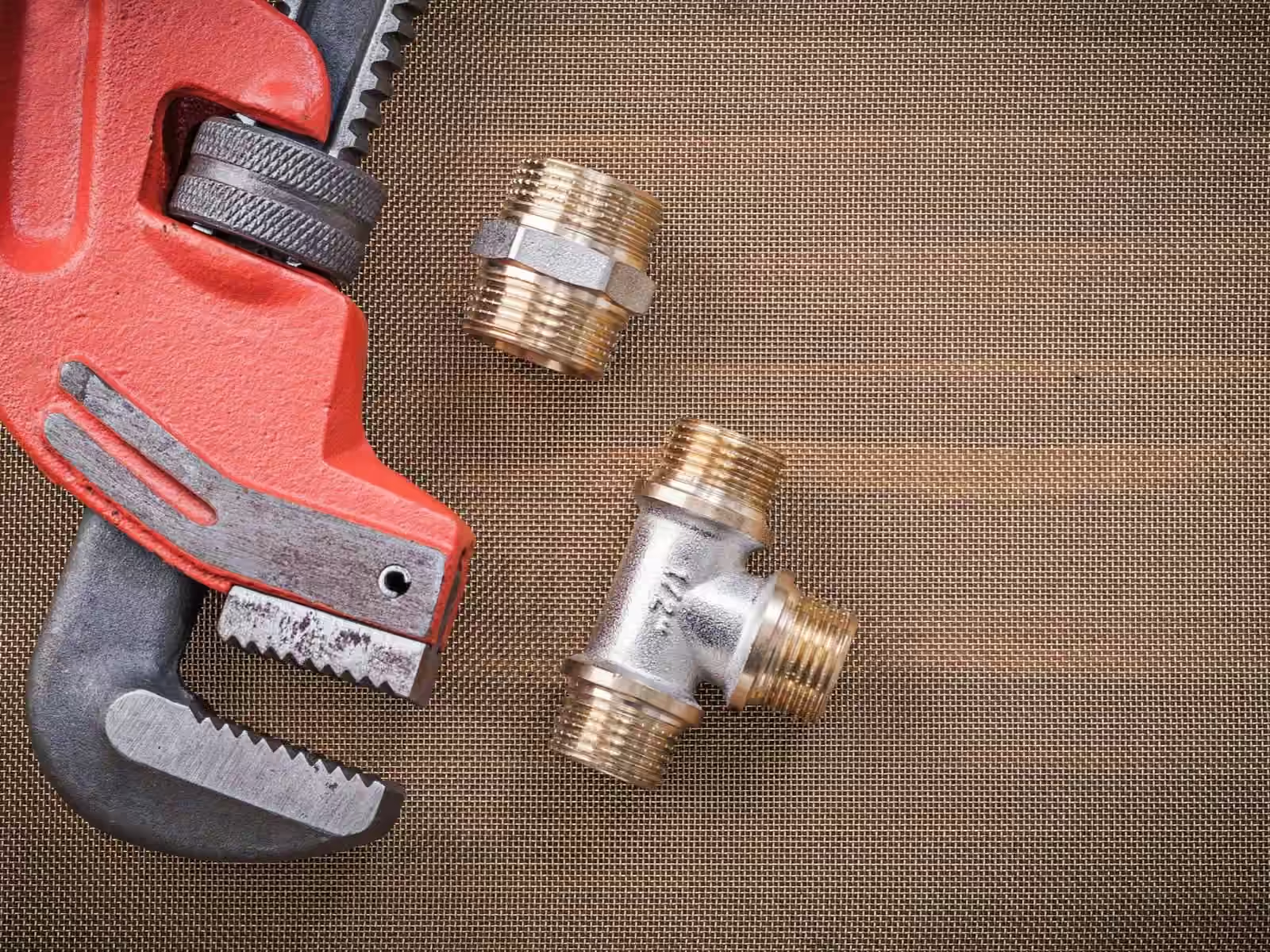
- Most Los Angeles houses have two shut-offs: a house valve where the supply line enters the building, and a second valve inside the concrete meter box at the curb.
- A ball valve closes with a quarter turn of its lever, while an older gate valve needs several clockwise turns of its round wheel.
- Gate valves in 1950s and 1960s Valley tract homes often seize or snap at the stem, so nobody should force a stiff one.
- The valve on the street side of the meter belongs to LADWP, and the utility can shut off service when nothing on the customer side will close.
- After closing the main, set the water heater to vacation or off, then open the lowest faucet to drain the pipes.
Where do you shut off the water main in a Los Angeles home?
Start at the front of the house. Most LA homes have no basement, so the valve that a national guide sends you downstairs for sits outdoors here. Look for a copper or galvanized pipe coming up out of the soil, usually within a few feet of the front hose bib. The valve sits on that riser, just before the pipe turns into the wall.
If it is not there, check three other spots. The garage wall nearest the street is common in 1950s-70s Valley tract homes, often beside the water heater. A side yard along the driveway comes next. Hillside homes in Studio City or Tujunga sometimes keep the valve in a small box at the low corner of the lot. On a 1920s bungalow, decades of additions can push it into a crawl-space hatch or behind a planter.
A short walk helps when shrubs hide everything. Find the concrete meter lid at the curb, then picture a straight line from it to the house. The buried service line usually follows that path, and the valve waits where it meets the wall. Once you find it, tie a bright tag on the handle and show everyone who lives there.
How do you close a gate valve versus a ball valve?
Two handle shapes cover nearly every house valve in the city. A ball valve has a flat lever. Swing it a quarter turn, until the lever points across the pipe instead of along it, and the flow stops.
A gate valve has a round wheel, like a garden spigot. Turn it clockwise, often several full turns, until the brass gate inside reaches its seat. A wheel that spins forever without getting tight has a broken stem, and the gate no longer moves.
Gate valves were the builder's standard when most of the Valley went up. After sixty years of hard LA water, scale coats the gate and the stem corrodes thin. Those 1950s valves seize in the open position, or the stem snaps the first time someone leans on the wheel. Firm hand pressure is the limit. Pliers and cheater bars turn a drip into a flood.
Test yours today. Close the valve, open a faucet indoors, and wait a minute. The stream should fade to nothing. If a steady trickle keeps coming, the valve no longer seals, which is worth knowing before the night you need it.
How does the meter box shut-off at the curb work?
The second place to shut off the water main is at the street. Look for a rectangular concrete lid in the sidewalk, the parkway strip or just behind the curb. Pry it up with a large screwdriver. The lid is heavy and black widows love these boxes, so wear gloves and look before you reach.
Inside you will see the meter and, on some LA services, a valve that an owner or plumber added on the house side of it. That customer-side valve is yours to use. Some have a small wheel or lever. Others have a flat brass tab that needs a meter key or a crescent wrench. Turn the tab a quarter turn, until it sits across the pipe.
The valve on the street side of the meter belongs to LADWP, along with the meter itself. The utility generally wants customers to leave that side alone. If your box has no customer valve, or nothing will turn, call the utility's round-the-clock line and ask for an emergency shut-off. Practices differ by agency, and Burbank, Glendale and Pasadena have water departments of their own.
A meter key is a plain steel T-handle that any hardware store carries. Keep one in the garage next to a flashlight. Meter boxes fill with dirt and roots over the years, so dig yours out on a dry weekend.
What are the steps, in order, when a pipe bursts?
Order matters, because each step protects the next one. Here is the sequence we talk callers through on the phone.
Close the house valve. If it is stuck or you cannot find it, go straight to the meter box instead.
Cut power to wet areas. If water runs through a ceiling light or pools near outlets, switch off those breakers before you walk in. If the panel is wet or you would have to stand in water to reach it, stay out and call the utility or 911.
Set a gas water heater to vacation or pilot. On an electric unit, turn off its breaker. A heater that keeps firing while the tank level drops can burn out an element or harm the tank.
Open the lowest faucet on the property, usually an outdoor hose bib or a ground-floor tub. Open one upstairs faucet too, which lets air in so the pipes drain faster.
Photograph the damage for your insurer, then start moving things out of the wet area.
Once the flow stops, the emergency becomes a repair. Our 24/7 emergency plumbing line reaches a live person at (818) 421-5290, day or night. With two people in the house, one should be dialing while the other runs to the valve.
Water and wiring meet more often than people think. A supply line that lets go in an attic soaks the recessed lights below it, and a garage water heater often stands a few feet from the panel. That is when it pays to call an electrician and plumber in Los Angeles who holds both licenses. One crew fixes the pipe and makes the wet circuits safe, with no finger-pointing between two companies.
Which valve do you close for which leak?
Not every leak needs the whole house dry. Small fixture stops, also called angle stops, sit under every sink and behind every toilet. Closing one isolates that fixture, and everyone else keeps their shower. The table matches each leak to the smallest valve that stops it.
Where the leak is, and which valve to close
| Where the leak is | Valve to close | Good to know |
|---|---|---|
| Toilet, faucet or the supply hose feeding one | Fixture stop behind the toilet or inside the sink cabinet | Turn it clockwise by hand. Sinks have two, hot and cold. |
| Washing machine hose | The two hose valves in the laundry box | Rubber hoses fail without warning. Braided steel lasts longer. |
| Water heater tank or its fittings | Cold inlet valve on the pipe above the heater | Set gas to vacation or off. Switch off the breaker on electric. |
| Sprinkler or irrigation line | Irrigation shut-off, often near the front hose bib | Sprinklers often branch off before the house valve, so that valve will not stop them. |
| Pipe inside a wall, ceiling or slab | House main valve | Drain the lines at the lowest faucet afterward. |
| Wet yard between the curb and the house | Customer-side valve in the meter box, or an LADWP emergency shut-off if there is none | The buried line from the meter to the house is the owner's to repair. |
| Water rising on the street side of the meter | None on your side, so call LADWP | The meter and the pipe toward the street belong to the utility. |
Fixture stops age just like main valves. The chrome multi-turn stops in older Valley bathrooms often drip from the stem once somebody disturbs them. Our residential plumbing service swaps tired stops for quarter-turn ones, usually while fixing whatever leaked in the first place.
What if your valve will not turn, or drips at its stem?
Stop pushing. A seized gate valve gives no warning before the stem shears, and then you own a valve stuck open with no handle. Go to the meter box and close the customer-side valve, or call LADWP if yours has none.
A drip at the stem is a smaller problem. Behind the wheel sits a packing nut that squeezes a seal around the stem. After years of sitting still, the seal dries out, and moving the valve makes it weep. Tighten that nut gently, a little at a time, until the drip stops. If it keeps dripping, the packing has worn out and the valve is due.
Sometimes the wheel turns fine and water still runs indoors. That means the gate or its seat has worn away, or a chunk of scale sits in the opening. Use the meter valve for now and plan a replacement.
Why replace the old gate valve before you need it?
A+ Electric & Plumbing is a licensed electrician and plumber serving Los Angeles and the San Fernando Valley, and a house valve that will not close is one of the small jobs our Tujunga shop handles most weeks. We shut the water at the meter, cut out the old valve and fit a full-port ball valve in its place. The estimate is free and in writing.
On a calm weekday, a valve swap with the meter closed is a short, tidy job. The same valve failing during a burst pipe means water keeps running while someone hunts for a meter key in the dark. A ball valve also shows its position at a glance, which matters when a house sitter or a teenager has to work it.
Look at what sits next to the valve while you are there. On most LA homes, a bell-shaped brass fitting follows the main valve within a foot or two. That is the pressure regulator, and it tames street pressure that runs high across much of the Valley and the foothills. Its adjusting screw is not a shut-off, so leave it alone during a leak.
Regulators wear out on a similar clock to gate valves, so we often replace both in one visit while the line is dry. Details are on our pressure regulator page. If the riser itself is rusty galvanized pipe, a water line repair or replacement may be the smarter fix. Current ranges are on that page.
Condo or apartment: unit valve or building valve?
Multi-unit buildings add a layer. Many condos from the 1980s onward have a unit shut-off, and it hides in predictable places. Check the water heater closet, under the kitchen sink, behind a hallway access panel, or in a balcony utility closet.
Older stock is different. The two-story dingbat apartments of the 1950s and 60s, common from Van Nuys to Palms, often have no unit valve at all. Your only tools are the fixture stops and the building valve, which usually sits near the meter, in the carport, or on the front wall. Closing it cuts water to every neighbor, so it is a last resort and usually the manager's call.
Ask now, not mid-flood. Renters should get the manager's after-hours number and ask where the building valve is. Condo owners should ask the HOA which valve serves their unit and whether a riser shut-down needs notice. Our Los Angeles plumbing team coordinates shut-downs with HOAs and managers when a repair needs the whole stack dry.
Earthquake readiness: water, gas and power in one walk
Every LA household should know three controls: the water main, the gas meter and the main breaker. After strong shaking, walk to each one. You are looking and listening first, not shutting everything by reflex.
- Water: if you hear running water or see a wet wall, close the house valve. Closing it also keeps the water in your heater tank clean if street mains break, and that tank makes a useful reserve.
- Gas: shut the meter valve only if you smell gas, hear hissing or see the dials spinning with every appliance off. Once it is off, leave it off, because SoCalGas has to restore service and relight the pilots.
- Power: if you see sparks, smell burning or have water near wiring, switch off the main breaker. Stand on a dry surface when you do.
Homes with a seismic gas shut-off valve handle the gas step on their own, but a typical house has nothing automatic on the water side. Keep a wrench and a meter key in the same spot, and tape a simple map inside the garage door. Anyone who lived through Northridge in 1994 remembers broken water lines and dark streets, which is a poor moment to learn where a valve is.
Frequently asked questions
Can I use the valve inside the meter box myself?
Using a customer-side valve, the one on the house side of the meter, is normal. The meter and the street-side valve belong to the utility, and utilities generally ask customers not to operate them. If that valve is your only option during a flood, call LADWP and ask for an emergency shut-off.
How often should I test my main shut-off valve?
Twice a year is a good habit, and the clock changes make an easy reminder. Close the valve fully, check that an indoor faucet runs dry, then open it again slowly. Regular movement keeps scale from locking the parts. If a gate valve starts to feel gritty or loose, stop exercising it and have it replaced while it still works.
Does closing the main hurt my water heater?
A short shut-off does no harm, because the tank stays full. The risk comes when the tank drains while the burner or elements keep heating. If you are draining the pipes, set a gas heater to vacation or pilot and switch off the breaker on an electric one. Restart everything only after water flows from a hot tap.
The house valve is closed, but my sprinklers still run. Why?
On many Los Angeles lots the irrigation line branches off the service pipe before it reaches the house valve. A broken sprinkler line therefore ignores the house valve. Look for a separate irrigation shut-off near the front hose bib or the backflow device. If you cannot find one, the meter box valve stops everything.
Should I shut off the water main when I leave on vacation?
For a trip longer than a few days, yes. It is simple insurance against a supply hose bursting in an empty house. Close the house valve, set the water heater to vacation and open a faucet briefly to relieve pressure. One catch: sprinklers or a pool autofill that connect after the house valve will stop too.
Related services
Need this handled? Start here
Get a free estimate
Tell us what's going on and a licensed tech calls you back fast, with the exact price before any work starts. Electrical and plumbing, one team.
Estimates for quoted work are free. Troubleshooting or diagnosis may carry a $100-$250 service call, credited to your repair when you approve the work.
- Exact price in writing before we start
- Licensed, bonded & insured (CSLB #942404)
- One team for electrical and plumbing
Prefer to talk? Call (818) 421-5290, answered 24/7.