
Whole-house & partial rewiring
House Rewiring in Los Angeles
House rewiring in Los Angeles is easy to budget for once you know the wiring behind your walls: we replace knob and tube, aluminum, and worn cloth wiring with grounded copper. Most 1,500 sq ft Valley homes take 3 to 5 days plus inspection. Every job is priced by its own access and layout, so our licensed electricians give you a free, room-by-room quote before we start.
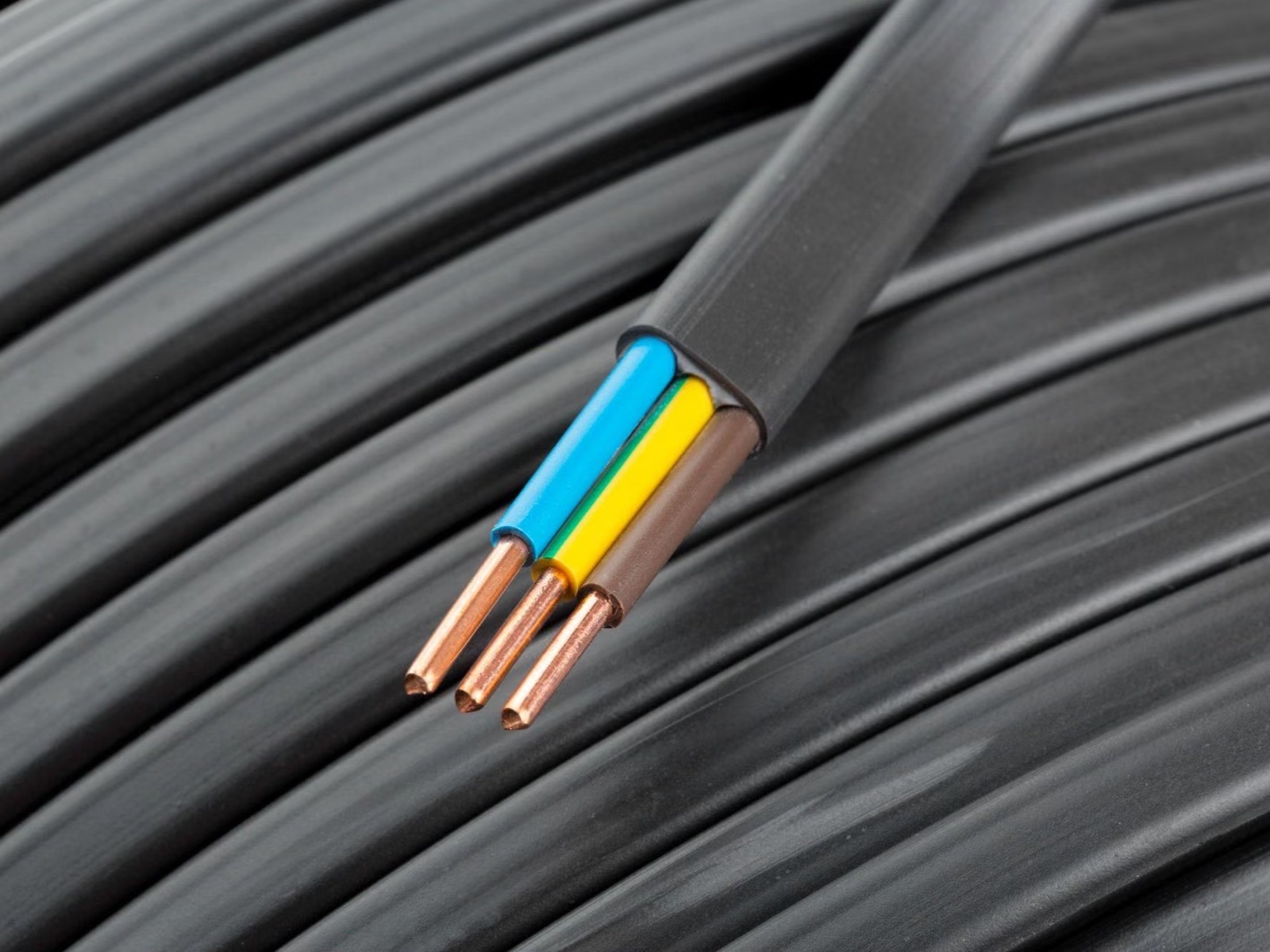
- $5-$15 per sq ft standard; knob and tube $10-$20 per sq ft (typical LA range)
- 1,500 sq ft home: 3-5 working days of wiring, plus city inspection
- Attic and crawlspace routing keeps most walls closed; rough patching included
- Licensed for both trades: pair your rewire with a repipe and open walls once
- Free exact quote in writing before we start: Call (818) 421-5290
How much does it cost to rewire a house in Los Angeles?
A full rewire runs $5-$15 per square foot, or $10-$20 per square foot when we are removing knob and tube. A 1,500 sq ft home usually lands between $8,000 and $20,000. If your panel also needs replacing, plan on another $2,500-$5,500. We quote the exact number, in writing, before we start.
If you are pricing house rewiring, Los Angeles bids swing widely because homes differ so much. For example, a one-story 1950s Sherman Oaks ranch with a roomy attic rewires faster than a two-story Studio City hillside home on a slab. Access drives labor hours, and labor is most of the bill.
Our number covers new copper cable to every outlet, switch, and fixture, grounded three-prong outlets, AFCI and GFCI protection where code requires it, permit fees, and rough drywall patching. In short, the price on paper is the price you pay, because we quote after measuring, not before.
House rewiring cost by home size in Los Angeles
| Job | Typical Los Angeles range |
|---|---|
| Standard rewire, per square foot | $5-$15/sq ft |
| Knob and tube replacement, per square foot | $10-$20/sq ft |
| 1,000 sq ft home | $5,000-$15,000 |
| 1,500 sq ft home | $8,000-$20,000 |
| 2,000 sq ft home | $10,000-$26,000 |
| Panel upgrade, often added | $2,500-$5,500 |
These are typical Los Angeles ranges for orientation, not a quote. Every job is priced by its own conditions, so your exact number comes from a free on-site look. Get a free estimate in minutes, or call (818) 421-5290.
Is knob and tube wiring safe or insurable in California?
Knob and tube wiring is not dangerous by design, but after 100 years it usually is. Most California insurers now decline new policies on homes with active knob and tube, or they add a surcharge until you replace it. Replacement costs $10-$20 per square foot. It usually starts with a letter from your insurer.
First, what it is. Knob and tube was standard wiring before about 1950: ceramic knobs hold single copper wires off the wood framing. Ceramic tubes protect them where they pass through joists. There is no ground wire at all, so three-prong outlets and surge protectors have nothing to ground to.
The design sheds heat into open air, and that is exactly the problem now. Blown-in attic insulation buries those wires in older North Hollywood and Burbank bungalows, so the heat stays trapped. Add modern loads (one hair dryer pulls about 1,500 watts) plus brittle 75-year-old insulation, and conductors crack behind your plaster.
That record is why knob and tube drives much of the rewiring LA insurers effectively require. Most carriers now decline new policies on homes with live knob and tube, and others surcharge until you replace it. After our knob and tube wiring replacement passes inspection, we hand you the permit record your insurer wants. Insurers ask about house rewiring in Los Angeles more than any other upgrade when a home is pre-1960.
Should aluminum wiring be pigtailed or fully replaced?
Full aluminum wiring replacement is the permanent fix, and pigtailing is the budget fix. Pigtailing splices a short copper lead onto each aluminum wire end with a connector rated for both metals. The outlets and switches only touch copper. It costs far less than a rewire, but it leaves 50-year-old aluminum in your walls. We will tell you plainly which one your home justifies.
Builders used aluminum branch wiring from about 1965 to 1973, when copper prices spiked. As a result, plenty of Woodland Hills, Northridge, and Tarzana tract homes from those years still carry it. The metal itself is not the flaw; the connections are, because aluminum expands, loosens, oxidizes, and then overheats at terminations.
Warm cover plates, flickering when you plug something in, and a faint hot-plastic smell at switches are the classic warnings. Homes of this era often pair aluminum wiring with Federal Pacific or Zinsco panels, brands with a documented failure record. If yours has one, fold a 200-amp panel upgrade into the project, typically $2,500-$5,500 on top.
Which fix, then? Full aluminum wiring replacement makes sense when you are already opening walls, staying 10 or more years, or seeing multiple warm outlets. Pigtailing works as a bridge, since it is code-legal with the right connectors. We quote both options side by side so you compare real numbers.
Can you rewire a house without opening all the walls?
Mostly, yes. We run most new wiring through the attic and crawlspace, then fish it down inside the walls to each outlet and switch. A typical rewire needs strategic cuts, small openings near some boxes and at blocked stud bays, not stripped rooms. Expect patching at those spots. We will tell you before we start exactly which walls get cut and who patches them.
Here is the part homeowners ask about first: the drywall. Our policy is explicit, and it is printed in every quote. We close and mud the openings we cut (rough patching included). Texture matching and paint stay with you or your painter.
One-story homes with accessible attics need the fewest cuts. That describes most 1950s ranch stock in Van Nuys and Encino. However, two-story homes and houses on slab foundations need more openings, because there is no crawlspace to route through. Fire blocking inside older walls also forces a small cut now and then.
A typical job: we lift the attic insulation, run new copper along the framing, then fish each drop down to the existing box with a flexible rod. Once the inspector signs off, we close every opening the same week.
How long does house rewiring take in Los Angeles?
Plan on 3-5 working days for a 1,500 sq ft home, plus the city inspection, which adds calendar days but not cost. Power stays on each night: we work circuit by circuit and reconnect before we leave. Larger homes, two-story layouts, and knob and tube removal add time, so we put your exact schedule in the estimate.
Most rewires follow the same sequence, and ours runs in five steps. Better yet, you know your dates before we start, because the schedule is written into the estimate. Most house rewiring in Los Angeles wraps up in under a week, inspection included.
- Walkthrough and written quote60-90 minutes
We map every outlet, switch, and fixture, then check the attic, crawlspace, and panel. You get one fixed price in writing, free.
- Permit filingusually 1-3 business days
We file the electrical permit with LADBS, or with the Burbank or Glendale building department if you live there, before any cable moves.
- Rough wiringdays 1-3
We run new copper through the attic and crawlspace, fish drops down to each box, and make only the strategic cuts we flagged in the quote.
- Devices and paneldays 3-5
We install grounded outlets, switches, and AFCI and GFCI protection, land the new circuits in the panel, and disconnect the old wiring.
- Inspection and patchingabout half a day on site
We meet the city inspector, walk the job together, and close and mud every opening after the pass.
What are the signs your home needs rewiring?
The clearest signs are breakers that trip weekly, outlets that are warm or buzzing, lights that dim when the AC starts, and two-prong outlets throughout the house. Also, any burning smell near a switch or panel is a call-now problem, not a someday one. One sign alone rarely means rewiring, but three or four together usually do.
- Breakers trip on ordinary loads, like a microwave and toaster running together
- Lights flicker or dim when large appliances start
- Outlets or switch plates feel warm, buzz, or crackle
- Two-prong, ungrounded outlets in most rooms
- Extension cords doing permanent duty because outlets are scarce
- A fishy or burning smell near outlets, switches, or the panel
- Fuses instead of breakers, or a panel brand like Federal Pacific or Zinsco
- Your home was built before 1950 and has never been fully rewired
One symptom on its own often has a smaller fix, so start with an inspection, not a contract. Our Los Angeles electrical team will tell you when a one-circuit repair beats a whole house rewire, because we quote both when both are honest options.
Do you need a permit to rewire a house in Los Angeles?
Yes. Every rewire needs an electrical permit and a city inspection, and we handle both for you. For house rewiring, Los Angeles city properties permit through the Department of Building and Safety (LADBS). Burbank and Glendale run their own building departments with their own inspectors. The permit protects you: it creates a record that the work passed inspection, which matters at resale and for insurance.
City of Los Angeles homes (Van Nuys, Encino, and Studio City included) go through the Los Angeles Department of Building and Safety. Burbank and Glendale are separate cities with their own counters, fees, and inspectors, so the paperwork differs a little. Either way, we file it, and the fee sits inside your quote.
Unpermitted wiring surfaces at the worst moment, during a sale, when the buyer's inspector finds it. You pay twice: once for the original work and again to open walls and prove it is safe. Also, before hiring anyone, verify their license for free at the Contractors State License Board. A legitimate electrician will encourage it.
Should you choose a partial rewire or a whole house rewire?
Do a partial rewire when the problem is contained: one addition with aluminum wiring, one knob and tube circuit left in the attic, or a kitchen that needs dedicated circuits. Choose a whole house rewire when the original wiring is failing everywhere, because partial fixes on a failing system just move the weak point. The comparison below shows how we make the call.
Partial rewire vs whole house rewire
| Partial rewire | Whole house rewire | |
|---|---|---|
| Scope | One room, addition, or a few circuits | Every circuit, box, and cable run in the home |
| Typical cost | A fraction of the full job, quoted free and exactly | $5-$15/sq ft, or $10-$20/sq ft with knob and tube (typical LA range) |
| Time on site | Usually 1-2 days | 3-5 days for 1,500 sq ft, plus inspection |
| Best for | Remodels, additions, one failing circuit | Pre-1950 wiring, aluminum throughout, insurer deadlines |
| Insurance effect | Helps only if it removes every flagged wire | Clears knob and tube and aluminum flags completely |
| Resale story | Old wiring still shows up in disclosures | Clean permit record for the entire house |
These are typical Los Angeles ranges for orientation, not a quote. Every job is priced by its own conditions, so your exact number comes from a free on-site look. Get a free estimate in minutes, or call (818) 421-5290.
Shoppers comparing whole house rewire cost in LA usually want one clean number. The honest answer is a range: $5,000-$15,000 at 1,000 sq ft, up to $10,000-$26,000 at 2,000 sq ft. For whole house rewiring, Los Angeles pricing lands inside that spread once we count circuits and access. A partial rewire only wins when the rest of the wiring is genuinely healthy. We test before we say it is.
Should you rewire during a remodel or repipe?
Your walls only open once, so yes, do it whenever you can. Rewiring and repiping both mean cutting drywall, routing new lines, passing inspection, and patching. When one licensed team handles both trades, you pay for that open-wall work once. You schedule one crew instead of refereeing two contractors. Since we hold both classifications, one call sets up both scopes, one schedule, and one invoice.
A+ Electric & Plumbing, a licensed electrician and plumber serving Los Angeles and the San Fernando Valley, runs both trades with one office and one schedule. That matters here because homes with pre-1950 knob and tube usually also carry pre-1960 galvanized steel pipe, which rusts shut from the inside.
When your Glendale or Burbank bungalow needs new wiring, ask us to scope a whole home copper or PEX repipe during the same walkthrough. The walls open once, the patching bill lands once, and one crew coordinates both inspections.
Rewiring during a remodel works the same way. Once your kitchen is down to the studs, wiring that zone costs a fraction of the closed-wall price, because the access is free. Tell your general contractor to slot us after demolition and before insulation. We will sequence any recessed lighting and LED work while the ceiling is open.
Frequently asked questions
Can I live in my house during a rewire?
Yes, and almost all of our customers do. We work in zones, keep dust contained, and restore power to the panel before we leave each evening. You will live around some furniture moving and small wall openings for 3-5 days. However, if you work from home, plan calls away from whichever rooms we are wiring that day.
Do you patch the drywall after rewiring?
We close and mud every opening we cut; that rough patching is included in our quote. Texture matching and paint are not included, because matching a 1950s hand trowel texture is a painter's craft, not an electrician's. Your written estimate states exactly who patches what, so nothing about the finish work is a surprise.
Does rewiring add value to my home?
Yes, mostly by removing a deal-killer. Buyers' inspectors flag knob and tube and aluminum wiring immediately, and lenders and insurers can stall a sale over them. A permitted rewire converts that red flag into a documented upgrade in city records. Grounded outlets and capacity for EV charging also matter to Valley buyers. Call (818) 421-5290.
How much does it cost to rewire a 1,000 sq ft house in Los Angeles?
Plan on $5,000-$15,000, the typical LA range. The low end fits a one-story bungalow with an open attic and easy crawlspace. The high end reflects knob and tube removal or slab construction. The spread is wide, so we give a free fixed quote after walking the actual house.
How do I know if my house still has knob and tube wiring?
Check the attic and basement first: look for white ceramic knobs holding single black wires off the framing. Two-prong outlets everywhere and a home built before 1950 raise the odds sharply. Even so, many Valley homes were partially rewired decades ago. We confirm what is live with a tester before quoting knob and tube wiring replacement in Los Angeles.
Is aluminum wiring illegal in California?
No. Aluminum branch wiring from the late 1960s is legal to keep, but it must be maintained. Many insurers surcharge it or require certified pigtail connectors. Full aluminum wiring replacement runs $5-$15 per square foot as part of a rewire. We quote pigtailing and replacement side by side. Call (818) 421-5290.
Will homeowners insurance pay for rewiring?
Usually not, because insurers treat old wiring as a maintenance issue rather than a covered loss. In fact, it often works the other way: the insurer requires the rewire as a condition of coverage. The good news is that replacing knob and tube or aluminum can reduce the surcharge you are already paying. Ask your agent what the new premium would be.
Do I need a panel upgrade with my rewire?
Often, yes. New circuits need breaker spaces, and many 1960s Valley panels are full, undersized at 100 amps, or a flagged brand like Federal Pacific or Zinsco. A 200-amp panel upgrade typically adds $2,500-$5,500. Doing it during the rewire is cheaper than doing it later, since the crew and permit visit are already there.
How long does the city inspection add to the project?
Typically a few calendar days, not extra labor cost. We request the inspection as soon as the wiring is done, then meet the inspector on site, which usually takes under an hour. City of LA runs through LADBS scheduling, while Burbank and Glendale book through their own building departments. We handle all of it. Call (818) 421-5290.
Can you rewire just one room or one circuit?
Yes. Partial rewires make sense for additions, a kitchen that needs dedicated appliance circuits, or one failing knob and tube run in the attic. If the same aging wire feeds the whole house, a partial fix just relocates the weak point. We test first, then quote the smallest job that actually solves your problem.
What kind of wiring do you install during a rewire?
Copper, in modern grounded cable (the yellow or white NM-B most people call Romex). Every circuit gets a ground, bedrooms and living areas get arc-fault breakers. Kitchens, bathrooms, and outdoor outlets get GFCI protection, because current code requires all three. As a result, your new system is built for today's loads: EV chargers, induction ranges, and home offices.
Should I rewire before or during my remodel?
During, whenever you can manage it. Rewiring during a remodel costs less because the walls or ceilings are already open. You skip most of the cutting and patching that drives the price. First we rough-in after demolition, then we finish devices after drywall. Tell us your contractor's schedule and we will match it. Call (818) 421-5290.
From our blog
Guides that answer the questions behind this job
Electrical Safety Inspection Checklist: What a Real Inspection Covers in an Older LA Home
An electrical safety inspection checklist for an older Los Angeles home covers the panel first.
Read the guide Electrical guideKnob and Tube Wiring: What Los Angeles Homeowners Should Know Before Escrow Closes
Knob and tube wiring is the original electrical system in most Los Angeles homes built before about 1950.
Read the guideWhere we do this work
Whole-house & partial rewiring across our service areas
Get a free estimate
Tell us what's going on and a licensed tech calls you back fast, with the exact price before any work starts. Electrical and plumbing, one team.
Estimates for quoted work are free. Troubleshooting or diagnosis may carry a $100-$250 service call, credited to your repair when you approve the work.
- Exact price in writing before we start
- Licensed, bonded & insured (CSLB #942404)
- One team for electrical and plumbing
Prefer to talk? Call (818) 421-5290, answered 24/7.