
Plumbing guide
Tankless vs Tank Water Heater: Which One Fits a Los Angeles Home?
Three things decide the tankless vs tank water heater question in Los Angeles: how many people shower at once, how long you plan to stay, and what your garage already has for gas pipe, venting, and power. A tank wins on simplicity and a quick like-for-like swap. A tankless unit wins on lifespan, floor space, and endless hot water, as long as you descale it yearly in our hard water.
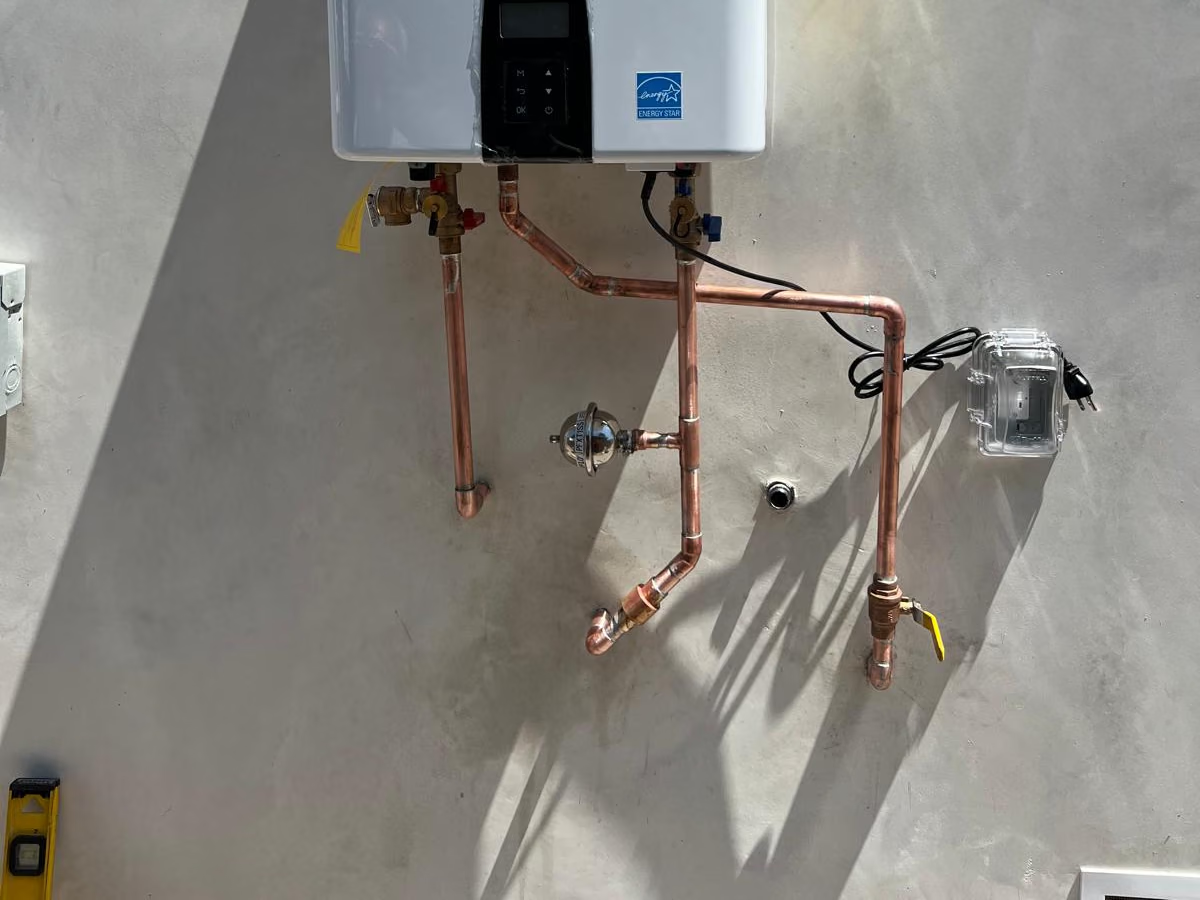
- A gas tank water heater typically lasts 8 to 12 years in Southern California, while a tankless unit with yearly descaling commonly passes 20.
- A gas tankless burner can draw up to 199,000 BTU, roughly four to five times a standard tank, so the gas line usually grows from 1/2 inch to 3/4 inch.
- Every gas tankless unit needs a 120-volt outlet for ignition, controls, and freeze protection, and it stops making hot water during a power outage.
- California code requires two seismic straps on a tank water heater, one in the upper third and one in the lower third.
- Los Angeles water tests hard to very hard, so a tankless heat exchanger needs descaling about once a year, or a softener ahead of it.
Tankless vs tank water heater: which one fits an LA home?
Neither one is the wrong answer. A tank stores 40 or 50 gallons, keeps it hot all day, and hands you a quick swap when the old one leaks. A tankless unit heats water as it passes through a burner, so it never runs out, never stores anything, and hangs on the wall at about the size of a carry-on bag.
What changes the answer is the house. A 1950s ranch in Van Nuys with a 1/2 inch gas line, a tight closet, and a 100-amp panel is one starting point. A remodeled Studio City home with a fresh gas meter and a garage wall to spare is another. We walk through each of those conditions below, then put them into one table.
The one thing this guide will not do is quote numbers. Each service page carries its own current ranges: the tankless water heater page for conversions and swaps, and the water heater installation page for tanks. This guide is about which one belongs in your house.
How does hard water change the answer in Los Angeles?
Los Angeles water arrives hard, and in the parts of the San Fernando Valley that draw on local groundwater it arrives very hard. Dissolved calcium and magnesium drop out of the water the moment it gets hot. Inside a tank that means sediment on the bottom, which rumbles, pops, and shortens the tank's life. Inside a tankless unit it means scale in the narrow passages of the heat exchanger, where it chokes flow and efficiency.
Scale is why tankless owners here descale about once a year. The service circulates a descaling cleaner through the exchanger using the isolation valves a careful installer leaves on the unit. Skip it for a few years and you invite error codes, slower hot water, and a warranty fight, since every major manufacturer ties coverage to maintenance.
A softener ahead of the heater slows that clock and protects the fixtures too. If you already know you want tankless, plan the softener as part of the same project; our water filtration and softener page explains the choice between a true softener and a salt-free conditioner. You can read the hardness numbers for your own neighborhood in the yearly water quality report from LADWP.
Does my gas line have to grow to 3/4 inch?
Usually, yes, and this is the item that surprises people. A standard 40-gallon gas tank burns around 40,000 BTU. A whole-house gas tankless unit can draw up to 199,000 BTU when two showers and the dishwasher run together. The 1/2 inch line that fed the tank cannot carry that much gas, so the burner starves and the unit shows an error code or delivers lukewarm water.
The fix is a larger line, most often 3/4 inch, from the meter to the unit. Sometimes the meter itself needs a capacity check with SoCalGas, since it has to carry the furnace, the range, and the dryer at the same time as the heater. A few models, such as certain Noritz EZ series units, run on an existing 1/2 inch line, which is worth asking about when the run is long.
Upsizing is a permitted plumbing job on its own, with a pressure test before the gas goes back on. Our gas line page covers the sizing, the materials, and what the inspector looks for. A tank, by contrast, almost never needs new gas pipe, which is a big part of why a like-for-like swap stays simple.
What happens with venting and the 120V circuit?
A tank vents through a metal flue by natural draft, and your existing flue usually serves the new tank as long as it is sound and slopes upward. A tankless unit cannot use that flue. Non-condensing models need stainless steel venting, because the exhaust runs hot. Condensing models run cooler and vent through PVC, but they produce a mildly acidic condensate that needs its own small drain line, with a neutralizer where code calls for it.
Outdoor units sidestep the venting question completely, and in our climate they are often the smartest mount. Built-in freeze protection covers the rare cold snap, as long as the unit has power. That last clause matters: a gas tankless unit goes dark in a power outage, while a standing-pilot tank keeps heating.
Which brings up the circuit. Every gas tankless unit needs a standard 120-volt outlet for ignition, the control board, and that freeze protection, and a garage water heater corner rarely has one. Most plumbers send you to find an electrician for it. A+ Electric & Plumbing is a licensed electrician and plumber serving Los Angeles and the San Fernando Valley on one license. The same crew wires the outlet during the install, and there is no second contractor to schedule.
Why do tanks in California need seismic straps?
A full 50-gallon tank weighs over 500 pounds, and a tank that tips in an earthquake tears its gas connection open. California code requires two straps anchored to the framing, one in the upper third of the tank and one in the lower third. The inspector checks the straps, the T&P discharge pipe that routes scalding overflow toward the floor, and often an expansion tank and drip pan.
Those items are part of why a tank swap in the City of Los Angeles still needs a plumbing permit through LADBS. Burbank and Glendale run their own building departments with the same strapping rule. A tankless unit hangs on the wall with its own bracket, so the strap rule does not apply, though the mount still has to hit studs and the inspector still looks at it.
Garage installs add one more item for a gas tank: an 18-inch stand so the burner sits above any fuel vapor at floor level, plus a bollard where a car could bump it. Wall-mounted tankless units clear both rules by design, which is one reason they suit a tight garage.
How long does each type last here?
Plan on 8 to 12 years from a gas tank in Southern California, and less if nobody ever flushes it. Sediment bakes onto the bottom, the anode rod wears out, and one day the liner fails and the garage floor is wet. A tank rarely gives more than a few weeks of warning.
A tankless unit with yearly descaling commonly runs past 20 years. The heat exchanger is the part that matters, and the major brands back it with long warranties, which they void when maintenance lapses. One tankless can outlive two tanks, and that closes more of the sticker gap than most people expect.
Lifespan also depends on the water. A softener helps both types, and it helps the tankless more, because its passages are narrow. If you sit in a hard-water pocket like Van Nuys or North Hollywood and skip both the softener and the descaling, expect the tankless unit to lose its lifespan advantage.
How many showers at once can each one handle?
A tank answers in gallons, a tankless unit answers in gallons per minute. A 40-gallon tank serves two or three people comfortably and a 50-gallon tank serves three to five. Either one runs out during back-to-back showers and then needs 30 to 60 minutes to recover.
A tankless unit never runs out, but it caps how much hot water flows at once. A shower uses about 2 gallons per minute and a kitchen faucet about 1.5. Add up the fixtures your household runs at the same time, and that is the flow the unit has to deliver. Incoming water in Los Angeles is mild, so the unit works less hard than it would in a cold climate. Most two- and three-bathroom Valley homes land on a unit rated for 7 to 9 gallons per minute.
Two quirks are worth knowing. A tankless unit pauses briefly between uses and can send a short slug of cool water mid-shower, the cold water sandwich, which a recirculating model or a small buffer tank smooths out. It also needs a minimum flow to fire, so a barely open faucet may get no hot water at all.
Which one should your household pick?
Find the row that sounds like your house.
Tankless vs tank: which fits which household
| Your situation | Better fit | Why |
|---|---|---|
| One or two people, one bathroom, staying a few years | Tank | Lowest complexity, quick like-for-like swap, no gas or venting changes |
| Family of four or more, two showers at the same time | Tankless, sized at 8 to 9 gallons per minute | Never runs out, while a 50-gallon tank cannot keep up with back-to-back use |
| Selling within two years | Tank | Buyers rarely pay extra for tankless, and the swap is simpler to permit |
| Staying five years or more | Tankless | Longer lifespan and lower energy use pay you back over time |
| Garage with a 1/2 inch gas line and no outlet | Either, with eyes open | Tankless needs the gas upsized and an outlet added; a tank needs neither |
| Hard-water pocket with no softener | Tank, or tankless plus a softener | Scale hits a tankless exchanger hardest, so yearly descaling is not optional |
| Tight closet, or you want the floor back | Tankless | Wall-mounted, and about 4 square feet of floor comes back |
| Frequent power outages | Standing-pilot gas tank | A gas tankless unit needs electricity to fire; a standing-pilot tank does not |
If your row says tank, a like-for-like swap is the honest recommendation. If it says tankless, the job is a conversion: gas line, venting, condensate, outlet, and permit, all quoted in writing before anything starts. The current ranges for each path live on the service pages linked above and across our plumbing services in Los Angeles.
Still on the fence about the tankless vs tank water heater question? Send a photo of the heater, the gas line behind it, and the panel, then call (818) 421-5290. As an electrician and plumber in Los Angeles, we can size the gas, the vent, and the circuit in one visit.
Frequently asked questions
Can a tankless unit go in the same closet as my old tank?
Often, yes. The unit is smaller, so space is rarely the issue. What decides it is the vent path to the outside and the condensate drain for a condensing model. A sealed-combustion unit pulls its air from outdoors through its own intake, so a closet works even without louvered doors. If the closet backs onto an exterior wall, the run is short and the job stays simple.
Is an electric tankless unit a way around upsizing the gas line?
Rarely for a whole house. A whole-house electric tankless unit can draw well over 100 amps on its own, which an older 100-amp Valley panel cannot spare, and a Federal Pacific or Zinsco panel should not carry at all. Electric tankless makes sense for a point-of-use spot like a back bathroom or an ADU. For a full house on gas, upsizing the line is usually the cleaner path.
Does a heat pump water heater change this comparison?
It adds a third option. A heat pump water heater is a tank that pulls heat from the surrounding air, so it uses a fraction of the electricity of a standard electric tank. It needs a dedicated 240-volt circuit, a garage or utility room with air to draw from, and a condensate drain. LADWP has offered rebates on them, and since we hold the electrical license, the circuit goes in with the tank.
Do I need a permit to replace a tank with another tank?
Yes. The City of Los Angeles requires a plumbing permit for every water heater replacement, tank or tankless, and LADBS inspects the result. The inspector checks the two seismic straps, the T&P discharge pipe, the venting, and any expansion tank or drip pan the setup needs. Burbank and Glendale run the same check through their own building departments. Skipping it tends to surface during a sale.
How do I know if my gas meter can handle a tankless unit?
Add up the BTU ratings of everything on gas: furnace, range, dryer, pool heater, and the new heater at its maximum draw. Compare that total with the capacity stamped on the meter. If the meter comes up short, SoCalGas can swap it for a larger one, which is a separate request from the plumbing permit. We run that total during the estimate so the answer is in the quote.
Why does my new tankless take longer to give hot water than the old tank did?
Because the unit has to sense flow and fire before it heats anything, and the hot water then has to travel the same pipe it always did. The old tank had hot water sitting ready. It is normal, not a defect. A recirculating model, or a small recirculation pump on a timer, shortens the wait at bathrooms far from the unit.
Related services
Need this handled? Start here
Get a free estimate
Tell us what's going on and a licensed tech calls you back fast, with the exact price before any work starts. Electrical and plumbing, one team.
Estimates for quoted work are free. Troubleshooting or diagnosis may carry a $100-$250 service call, credited to your repair when you approve the work.
- Exact price in writing before we start
- Licensed, bonded & insured (CSLB #942404)
- One team for electrical and plumbing
Prefer to talk? Call (818) 421-5290, answered 24/7.