
Electrical guide
Is a Whole House Surge Protector Worth It in Los Angeles?
Yes, for most Los Angeles homes a whole house surge protector is worth it, and the case has nothing to do with lightning. A panel-mounted device clamps the spikes that come from utility switching, heat-wave brownouts, and your own air conditioner cycling, before they reach the control boards in your HVAC, EV charger, and kitchen. Plug-in strips still have a job, as the second layer at the desk.
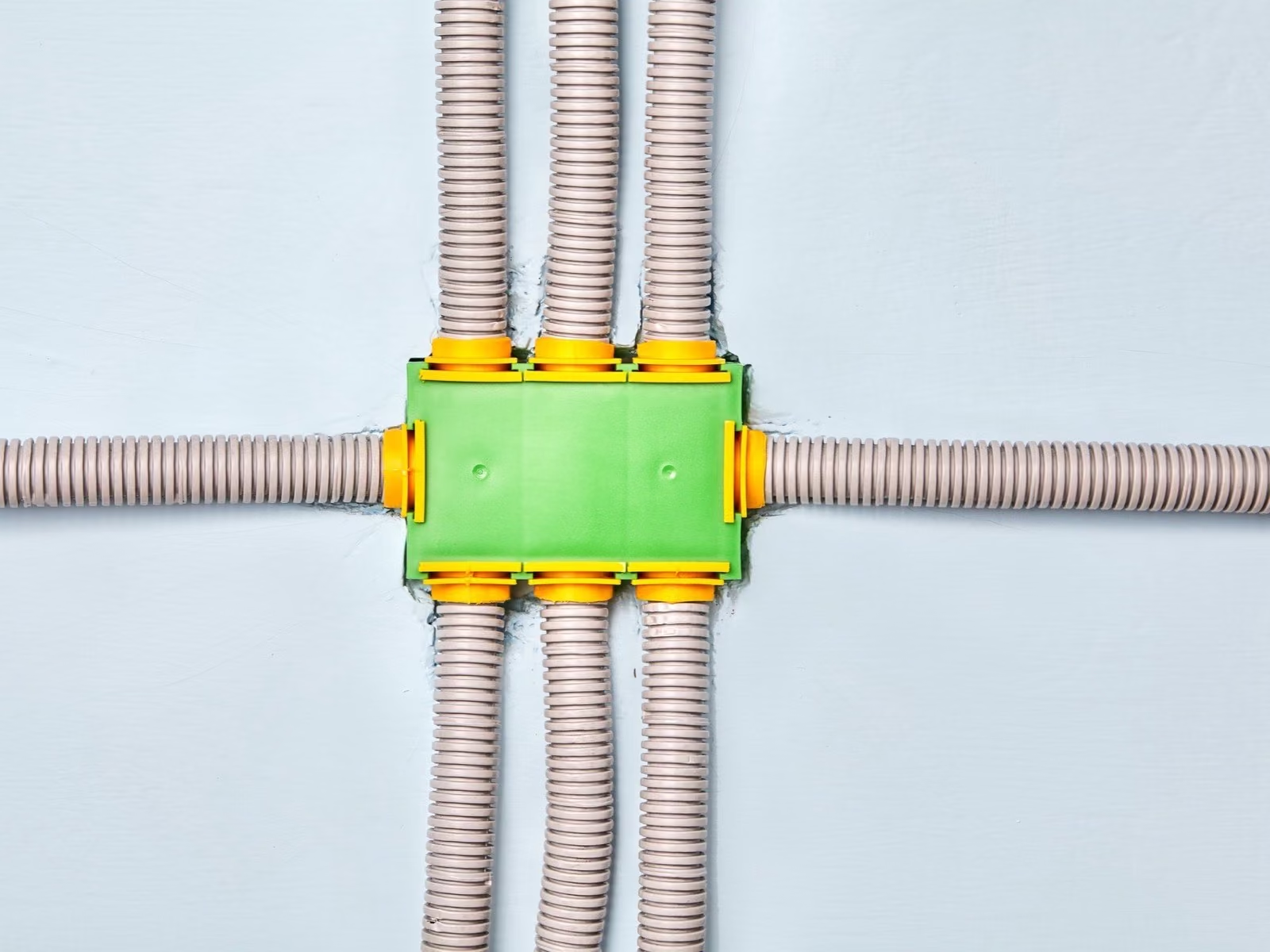
- A whole-house surge protective device mounts at or beside the main panel and clamps spikes for every circuit, including hardwired gear a power strip can never reach.
- Los Angeles surges come from utility switching, heat-wave sags, and the recovery after an outage, plus motors cycling inside the house, not from lightning.
- The California Electrical Code, following the 2020 NEC, calls for a surge device whenever a crew installs or replaces a dwelling service panel.
- Panel units and plug-in strips work as layers: the panel unit knocks a big surge down, and the strip trims what is left.
- Surge devices wear out with every hit they absorb, and a dark indicator light usually means the unit has done its job and needs replacing.
Is a whole house surge protector worth it in Los Angeles?
For most homes, yes. Count what runs on a circuit board today: the furnace or heat pump, the fridge, the dishwasher, the garage door opener, the EV charger, and every screen in the house. One bad spike can take out several of those boards in the same instant, and the board is often the priciest part inside the appliance.
The device itself is a small box with three or four leads. It sits in or beside the panel and waits. Most weeks it does nothing you would notice, and that is the point. The small spikes it trims all day are what age electronics early, and the rare big one is what kills them outright.
Current ranges for a panel-mounted unit are on our whole-house surge protection page. Skip the device only if you own nothing with a circuit board, which describes almost no home in the Valley now.
What does a panel-mounted device do that a power strip cannot?
A surge protective device, SPD in the trade, watches the voltage between each hot leg and neutral. Normal service voltage passes through untouched. When a spike climbs past the threshold, the metal oxide varistors inside turn conductive within nanoseconds and shunt the extra energy to neutral and ground. Voltage at your outlets stays close to normal while the spike bleeds off.
A power strip does the same job with much smaller parts, on one cord, for one cluster of gear. It cannot absorb a large event, and it cannot help anything hardwired: the air handler, the range, the water heater, the charger on the garage wall. Those loads carry the most expensive boards, and only a device at the panel stands in front of them.
The two are not rivals. A panel unit takes a big hit down to a level a strip can finish, so the layered setup is what we suggest on nearly every house.
Type 1, Type 2, Type 3: which layer goes where?
The type number tells you where the device sits, not how good it is. A Type 1 unit connects on the line side of the main breaker, at or near the meter. A Type 2 unit connects on the load side, inside the panel or in a small box beside it, on its own two-pole breaker. Many current residential units carry both listings, so the same box can go in either spot.
A Type 3 device is the strip, the wall tap, or the receptacle with a surge module built in, and it belongs within a few feet of the gear it protects. On an existing home we install a Type 2 unit almost every time, since it goes in without touching the utility side of the meter. During a service change the line side is already open, and a Type 1 unit on the line side becomes an option where the utility and the equipment listing allow it.
Whole-house SPD vs plug-in strip: what each one covers
| Feature | Whole-house SPD (Type 1 or 2) | Plug-in strip (Type 3) |
|---|---|---|
| Where it mounts | At the meter, or in or beside the main panel | At the outlet, on the cord of one device |
| What it covers | Every circuit in the house, hardwired loads included | Only what plugs into that strip |
| Surge current it handles | Tens of kA per phase | A few kA at most |
| Air handler, range, EV charger | Covered | Not covered |
| Who installs it | A licensed electrician, with a permit in most cities | You, in seconds |
| How you know it is spent | Indicator light; some models take a new module | A small light that often dies unnoticed |
| Best role | First line, knocks a big surge down | Second line, trims the rest at the desk |
Where do surges come from in Los Angeles if not lightning?
Los Angeles sees only a handful of thunderstorm days a year, so lightning sits at the bottom of the list here. The spikes that reach a Valley panel come from the grid doing routine things. LADWP and the neighboring utilities switch capacitor banks and reroute feeders every day, and each switch leaves a ripple on the line. A blown transformer fuse or a crew clearing a fault adds a bigger one.
Summer is the season for it: on a heat-wave afternoon in Van Nuys or Northridge, every compressor on the block runs at once and the voltage sags. A sag is not a surge, and a surge device does nothing for it. The trouble comes when the load drops or the utility restores power after an outage. Voltage swings back hard, and that swing is what we find behind fried HVAC boards after every big outage.
The rest starts inside the house. A compressor, a pool pump, or a heat pump is a motor with a coil, and a coil that shuts off dumps its stored energy back into the wiring. The relay in an EV charger dropping out under load leaves a smaller kick of the same kind. These internal spikes are small on their own, and they happen thousands of times a year.
What in the house is actually at risk?
Anything with a control board, which now means most of the house. Here is the list we walk through with owners, roughly in order of how much a replacement hurts.
- Variable-speed HVAC and heat pumps: the inverter drive that makes them efficient is also the part a spike kills first.
- EV chargers: the charging electronics and the communication board sit on a 240-volt circuit around the clock, so they see every grid event.
- Induction ranges and modern ovens: touch controls and power electronics replaced the old mechanical switches.
- Solar inverters and batteries: always on, and tied directly to the utility grid through the panel.
- Home office gear, routers, and the smart TV: replaceable, though the data on them may not be.
- Fridges, washers, dryers, and dishwashers: the boards in current models make up a large share of the appliance's value.
The same list shows why a strip alone falls short. Four of those six items never plug into a strip. If you are planning an EV charger installation, ask for the surge device on the same visit, because the charger circuit is the one that rides through every summer outage.
Does the electrical code require surge protection on a new panel?
Yes, on new and replaced services. The rule arrived with the 2020 National Electrical Code, and the California Electrical Code that adopted it calls for a Type 1 or Type 2 surge protective device whenever a crew installs or replaces the service panel on a dwelling. The cycles since have kept it. Adding a circuit to an existing panel does not trigger the rule on its own; changing out the service equipment does.
That timing is why we bundle the two jobs. During a panel upgrade the panel is open, the utility has dropped power at the meter, and the inspector expects to see the device. Adding it later means a second trip and a second shutdown. Inside the City of Los Angeles the inspection runs through LADBS, while Burbank, Glendale, and Pasadena run their own counters, and their inspectors look for the same box.
An existing home is under no obligation to add a whole house surge protector, and no inspector will ask about it unless the panel changes. The rule exists because the count of circuit boards in an average home crossed a line.
How do you read kA, clamping voltage, and the indicator light?
Spec sheets for whole-house units lean on four numbers. Here is what each one means in plain English.
- kA rating: the largest surge current the device can pass to ground without destroying itself, listed per phase or per mode. Residential units run from about 40 kA to well past 100 kA. A higher number is less about stopping one giant event and more about surviving many smaller ones over the years.
- Clamping voltage, or VPR: the voltage that reaches your gear while the device works. Lower is better, and on a 120/240-volt home a VPR of 600 volts or below is a good target.
- UL 1449 listing: the safety standard for surge devices. A unit without it has no business inside a panel.
- Joules: common on strips, less useful on panel units. The number hints at total energy the device can absorb over its life, but makers measure it in different ways.
The indicator light is the feature people forget until it matters. Green means the unit is live and protecting. A dark or red light usually means the varistors inside have sacrificed themselves, and the box is now decoration. Some units add an audible alarm or dry contacts for a smart panel, and the better ones let you swap the spent module without pulling the whole device.
Where does the device mount, and why do short leads matter?
A Type 2 unit wants to sit as close to the bus bars as the panel allows, on a dedicated two-pole breaker, with the leads run straight and short. Every foot of wire between the breaker and the device adds voltage to whatever gets through, because a surge rises faster than a long lead can carry it. We trim the leads, avoid sharp bends, and land them on a breaker near the top of the panel.
Some brands make a breaker-style unit that snaps into two slots and needs no outside box. Others mount through a knockout in the side of the panel. Both work, and the panel decides. A 1960s Valley panel that is already full sometimes has no room for either, and that conversation turns into the panel upgrade one.
The device also needs a sound ground to shunt into. Neutral and ground bond together at the service, so a panel unit protects even a 1950s house full of two-prong outlets. A strip plugged into one of those outlets has no ground to shunt into and loses most of its protection, a detail we point out on a lot of older Sunland and Tujunga homes.
How long does a whole-house unit last, and how do you know it is spent?
Several years to a decade is typical, though the honest answer is that it depends on how many hits the unit takes. Each surge burns a little of the varistors' capacity. A unit on a quiet feeder in Encino may outlive one in a Sun Valley industrial pocket where big motors start and stop all day.
The device tells you itself. Glance at the light after any outage or a dramatic flicker, and add it to the list of things you check when you change smoke detector batteries. A dark light usually means the unit absorbed a hit bigger than it could survive, which is the whole idea. Have an electrician confirm its breaker has not simply tripped, then replace it, and be glad it went instead of the heat pump.
A+ Electric & Plumbing is a licensed electrician and plumber serving Los Angeles and the San Fernando Valley, and we fit a surge device on nearly every panel we replace, then check the light again on later visits. One license covers both trades, so the crew that wires the panel can also look at the water heater and its gas line on the same trip, with nobody pointing at another contractor. Our Los Angeles electrician team puts the estimate in writing for free, and if you would rather talk it through first, a licensed electrician and plumber in Los Angeles answers (818) 421-5290 at any hour.
Frequently asked questions
Will a whole house surge protector help during a brownout?
Not with the sag itself. A brownout is low voltage, and a surge device only acts when voltage climbs past its threshold. Where it earns its keep is the recovery: when the utility restores power or a big load drops off, voltage overshoots for an instant, and that overshoot is the spike the device clamps. If your lights dim every time the AC starts, mention it; that is a separate wiring or utility question.
Do I still need power strips if I have a panel device?
For the desk, the media wall, and anything holding data, yes. The panel unit knocks a large surge down to a few hundred volts, and a good strip trims that remainder to a level a router barely notices. Buy strips with a UL 1449 listing and a clear status light, and retire any strip whose light has gone dark, since the surge parts inside are gone even though the outlets still work.
Can a surge device protect my solar system?
It covers the inverter's grid side, which is where most utility spikes arrive. A panel-mounted unit sees the same bus the inverter feeds, so it clamps events coming in from the street. The DC side, from the roof to the inverter, needs its own DC-rated device at the combiner or inside the inverter, and many modern inverters include one. Ask your solar installer which side theirs covers, then add the panel unit for the rest.
Does adding a surge protector need a permit in Los Angeles?
In most cases, yes, since the device lands on a new breaker inside the service panel. In the City of Los Angeles that runs through LADBS, and the smaller cities run their own building departments. When the device rides along with a panel upgrade it goes on that permit, and the inspector checks it during the service inspection. Be wary of any quote that leaves the permit out.
Will the surge protector trip my breakers or slow my power?
No. In normal operation it draws almost nothing and sits off to the side of your loads, so nothing dims or slows. Its own breaker exists to disconnect the device if the varistors ever fail shorted. If that breaker trips, the device has most likely done its job and needs replacing, while the rest of the panel keeps running. A tripped SPD breaker is a signal, not a fault in the house.
What happens to the device in a real lightning strike?
A direct strike on the house or the service drop carries more energy than any residential device can absorb, and the unit will sacrifice itself trying. Nearby strikes, which are the realistic case in Los Angeles, induce spikes that a panel unit handles well. The device buys a wider margin and usually a connected-equipment warranty; it is not a lightning rod, and the two guard against different things.
Related services
Need this handled? Start here
Get a free estimate
Tell us what's going on and a licensed tech calls you back fast, with the exact price before any work starts. Electrical and plumbing, one team.
Estimates for quoted work are free. Troubleshooting or diagnosis may carry a $100-$250 service call, credited to your repair when you approve the work.
- Exact price in writing before we start
- Licensed, bonded & insured (CSLB #942404)
- One team for electrical and plumbing
Prefer to talk? Call (818) 421-5290, answered 24/7.