
Electrical guide
Breaker Keeps Tripping? What the Pattern Tells You Before You Reset It Again
A breaker keeps tripping for one of three reasons: an overload, a short circuit, or a ground fault. The timing tells them apart. A trip minutes after a heavy appliance starts is an overload. A trip the instant you reset the handle is a short. A GFCI that trips near water with nothing running is a ground fault. Unplug everything on that circuit and reset once. If it trips again, leave it off.
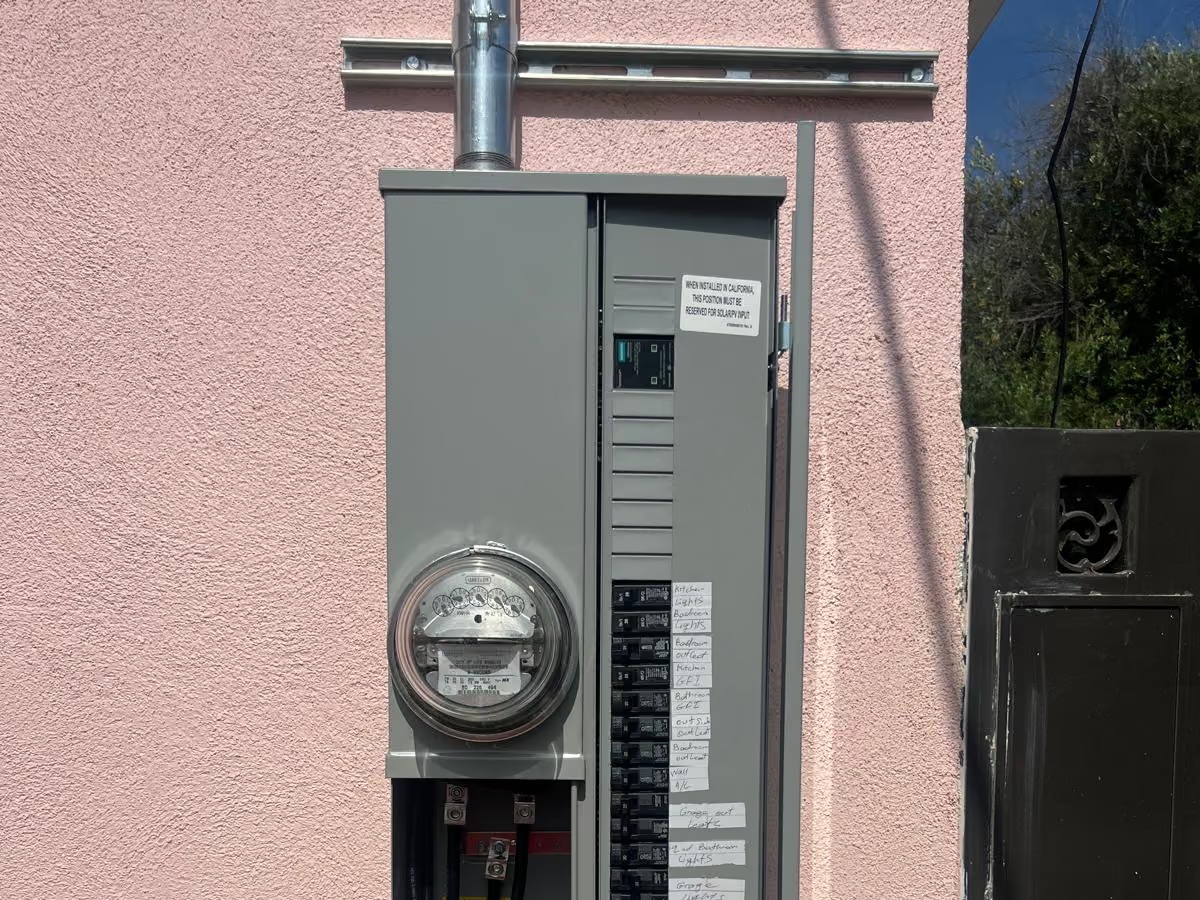
- A breaker that trips minutes after a heavy appliance starts is reacting to an overload; one that trips the instant it resets has a short circuit.
- A microwave and a window air conditioner together draw more than one 15-amp kitchen circuit can carry, one of the most common trips we see in 1960s Valley homes.
- A breaker that feels warm, buzzes, smells like hot plastic, or will not stay on has moved past troubleshooting into emergency territory.
- Federal Pacific and Zinsco breakers can trip late or not at all, so a circuit that never trips on one of those panels is not proof of health.
- A 20-amp breaker on a 15-amp circuit removes the protection instead of fixing the cause, because the wire behind the wall keeps its 15-amp limit.
Overload, short circuit, or ground fault: which one keeps tripping your breaker?
A breaker has one job: open the circuit before the wire behind your drywall gets hot enough to matter. It trips for three different reasons, and each leaves a different fingerprint. Read the fingerprint and you know whether you have a habit problem, a damaged wire, or moisture where it does not belong.
An overload is the everyday case. The circuit is healthy, but the things plugged into it draw more current than the wire can carry. A bimetal strip inside the breaker warms up with the wire and bends until the contacts open. That takes seconds to minutes, so an overload trip always lags the load.
A short circuit is a hot conductor touching a neutral or a ground. Current jumps to many times the rating in a fraction of a second, and a magnetic element inside the breaker snaps it open at once. A pinched cord, a nail through a cable, or a bare wire in a crowded box are the usual causes.
A ground fault is current leaking out of the circuit toward ground on a path it should not use, often through water or a person. A GFCI compares the current going out with the current coming back and trips on a difference of a few thousandths of an amp. That is why a garage outlet trips with nothing running: moisture or a cracked cord is leaking.
How does the trip pattern point to the cause?
You can read most of this at your own panel before anyone opens a wall. Note what was running, how long it ran, and how fast the handle went, then match the row below.
Trip pattern, likely cause, and what fixes it
| Trip pattern | Likely cause | What fixes it |
|---|---|---|
| Trips minutes after a heavy appliance starts; resets once it cools | Overload: more draw than the circuit rating | Move the load, or add a dedicated circuit |
| Trips the instant you flip it on, everything unplugged | Short circuit in a device, cord, box, or cable | Repair the damaged wiring or device; stop resetting |
| Trips only while one appliance runs, on any outlet | Failing motor, element, or cord in that appliance | Repair or replace the appliance |
| GFCI trips near water, sometimes with nothing running | Ground fault: current leaking through moisture or a damaged cord | Dry the box, replace the cord or device, check downstream outlets |
| AFCI trips at random on a bedroom circuit | Arcing at a loose connection or worn cord, or a motor the breaker misreads | Tighten every termination; replace the device; update an early AFCI |
| Trips below its rating, feels warm, or will not stay on | Weak breaker, common in Federal Pacific and Zinsco panels | New breaker at the same rating; new panel if FPE or Zinsco |
| Several breakers trip, lights flicker, bulbs burn out early | Loose neutral at the panel or on the utility side | Remake the neutral; hand it to the utility if the fault is theirs |
Write down the pattern and the appliance before you call. That one detail usually rules out two of the three causes before the truck leaves the shop.
Which appliances trip breakers in older Los Angeles homes?
Builders wired the Valley's 1950s and 1960s tract kitchens for a toaster and a refrigerator. Many still run on a single 15-amp circuit that also feeds the dining room outlets.
A microwave by itself draws close to 12 amps. Add a window air conditioner on a hot September afternoon and the breaker keeps tripping a few minutes in, every time. The wiring is fine; the demand doubled.
Bathrooms tell the same story. Older homes share the bathroom outlet with hallway lights or a bedroom, so a hair dryer and a curling iron running at once push a 15-amp circuit past its limit. Current code wants a dedicated 20-amp bathroom circuit, so a permitted remodel usually cures this for good.
Space heaters are the winter version. A typical unit pulls about 12.5 amps on high, which leaves almost nothing for the lamp, the TV, and the phone chargers on the same run. Two heaters on one circuit trip it without fail, and an extension cord under a rug adds a fire risk.
A few loads trip breakers because they are failing, not because they are large. A refrigerator compressor with worn bearings, a disposal jammed on a peach pit, or a cracked water heater element that now touches the tank all pull too much or leak to ground. If the trip follows one appliance from outlet to outlet, the appliance is the fault.
Can a bad breaker be the problem?
Sometimes, and the panel label is the first clue. Breakers are mechanical, and they age. One that has tripped dozens of times, or spent forty summers in a Van Nuys garage, can weaken until it opens below its rating. That looks like an overload with none present: the meter reads nine amps on a 20-amp breaker and it still lets go.
Federal Pacific and Zinsco panels fail in the opposite direction. Their breakers have a documented habit of tripping late or not at all, so a real overload can cook the wire while the handle stays on. If your 1960s house in Sherman Oaks or Northridge wears one of those labels, a circuit that never trips is not good news. Our Federal Pacific and Zinsco guide covers why.
A loose neutral is the sneaky one. It does not overload anything, so an ordinary breaker sits quietly. Instead the connection arcs, and arcing is exactly what an AFCI breaker listens for.
Random AFCI trips, lights that brighten when a big load kicks on, and bulbs that burn out young are the pattern. The fix lives at the panel or in a junction box.
Arc-fault breakers reached California bedrooms in the mid-2000s through the California Electrical Code, which follows the NEC, and early models react to old vacuum motors and some dimmers that mimic an arc. On 1960s wiring with backstabbed outlets, the breaker may also be reporting real arcing, and a load test plus a look inside the boxes sorts the two apart.
What can you safely do before calling?
Plenty, and none of it needs a screwdriver. Start by unplugging everything on the affected circuit, including the lamp in the next room that shares it. Look at the handle at the panel.
A tripped breaker usually rests in the middle, between on and off. Push it firmly to off, then back to on. That is the reset, and you get one.
If it holds, plug things back in one at a time and wait a few minutes between each. The item that trips it is your first suspect, so move it to an outlet on a different circuit and see whether the trouble follows.
If it trips again with nothing plugged in, stop. That is a short circuit or a failing breaker, and each reset pushes more current into the fault. Leave the breaker off. A GFCI outlet has its own reset button, and the same rule applies: press it once, and if it will not hold, leave it alone.
Never swap in a bigger breaker, never bypass a GFCI with an adapter, and keep the panel cover on, since the lugs inside stay live even with the main off.
When should you stop resetting the breaker?
A breaker that trips is protecting you, and there is a point where the protection itself is at risk. Stop resetting and switch the breaker off when you notice any of the following.
- The breaker or the panel cover feels warm to the touch.
- A burning or fishy plastic smell near the panel, an outlet, or a switch.
- Buzzing, crackling, or sizzling from the panel or a device on the circuit.
- Brown or black scorch marks on the breaker, an outlet, or a faceplate.
- The handle will not stay on, or trips the moment you let go of it.
- The breaker is off but something on the circuit still has power, a sign of a bad breaker or crossed wiring.
Each of those means heat is already building at a connection, and every reset feeds it. Shut the breaker off. If the panel itself smells hot or buzzes, shut off the main only if you can reach it safely, with dry hands and no smoke or heat at the panel. If you see smoke or flames, get everyone out and call 911. Our emergency electrician team treats a breaker that will not hold and a hot panel as an emergency call, and a live person answers (818) 421-5290 at any hour.
A breaker that trips once a month under a known load is a different animal. It needs fixing, but it belongs on the schedule, not on the after-hours line.
What does the electrician actually do on the visit?
The visit starts at the panel, not at the outlet. We pull the cover, look for heat marks and loose terminations, and read each breaker's rating against the wire behind it. A 20-amp breaker feeding 14-gauge wire is an old shortcut that explains a lot of warm outlets.
Next comes the clamp-meter load test. A clamp meter reads current through a wire without touching bare copper, so we clip it around the circuit's hot conductor, run your usual loads, and watch the amps. Eleven amps from the microwave alone explains why the window AC tips a 15-amp circuit over. Two amps with the breaker still tripping points at a weak breaker or a short.
Circuit tracing maps which outlets and lights live on the run, and after three remodels the map is often a surprise. A tracer finds the garage outlet nobody knew shared the kitchen breaker. From there we test for a short with the loads off and open the suspect boxes.
The fix follows the finding. An overload gets a split: a new home run from the panel so the microwave or the AC has its own 20-amp circuit. A weak breaker on a modern panel gets a new one at the same rating.
In the City of Los Angeles a new circuit is permit work through LADBS, while Burbank, Glendale, and Pasadena run their own desks. All of it falls under electrical repair, and current ranges are on that page.
When is the real answer panel capacity?
Some houses trip breakers on several circuits, not one. That pattern is the panel telling you it belongs to a different decade. A 100-amp panel carrying central air, an electric dryer, a modern kitchen, and an EV charger is out of room, and shuffling loads only moves the problem around.
The signs are easy to spot: no empty slots, tandem breakers wherever they fit, a main that trips on hot afternoons, and lights that dim when the compressor starts. We run a load calculation, the code's tally of everything the house draws, and the total either fits the panel or it does not. When it does not, the honest answer is a panel upgrade to 200 amps, which also retires a Federal Pacific or Zinsco can.
A+ Electric & Plumbing is a licensed electrician and plumber serving Los Angeles and the San Fernando Valley, and the tech who traces your tripping circuit carries the plumbing license on the same truck. A dishwasher dripping onto its own outlet or a water heater leak soaking a junction box starts as plumbing and shows up as electrical. One crew handles both, with nobody pointing at another contractor.
If the breaker keeps tripping after you have unplugged the circuit and reset it once, leave it off and call (818) 421-5290. See what our Los Angeles electricians handle, or start with a free written estimate from an electrician and plumber in Los Angeles who would rather split a circuit than sell you a panel you do not need.
Frequently asked questions
Can I put in a bigger breaker so it stops tripping?
No. The breaker rating matches the wire gauge, and the wire is the part that burns. A 15-amp circuit runs on 14-gauge copper, and a 20-amp breaker lets that wire carry heat it cannot shed. The trips stop, and the wire inside the wall becomes the weak link. If a circuit needs more capacity, the fix is a new circuit on heavier wire.
Why does the breaker trip only when the AC and the microwave run together?
Each one fits on the circuit by itself. A window air conditioner draws roughly 6 to 10 amps once running, and a microwave about 10 to 13, so together they pass the 15-amp rating. The breaker warms up with the wire and opens after a few minutes. A dedicated 20-amp circuit for the microwave stops the trips for good.
Why does my outdoor GFCI trip when it rains?
Water is getting into the box or into a cord plugged into it, and the GFCI is doing its job. Check that the in-use cover closes over the plug, unplug string lights and pumps, and let the box dry. If it still trips with nothing plugged in, a downstream outlet or a buried splice is wet, which is a tracing job for an electrician.
How many times is it safe to reset a tripped breaker?
Once, with the circuit unloaded. A breaker that trips on a short pushes a burst of fault current into the damaged spot on every reset, and each burst adds heat. Breakers also wear a little with every trip, so a handle you have cycled twenty times is now part of the problem. Unplug, reset once, and leave it off if it trips again.
Does a tripping breaker mean I need a new panel?
Usually not. If one breaker keeps tripping and the rest of the house behaves, the cause is an overload, a short, or a failing appliance on that circuit, and a repair or a new circuit settles it. The panel becomes the answer when several circuits trip, no slots are free, or you are adding central air or an EV charger.
Is a breaker that never trips a good sign?
Only on a modern panel. On a Federal Pacific or Zinsco panel, a kitchen that runs the microwave and a window air conditioner on one 15-amp circuit without ever tripping is a warning, not a comfort. The breaker may be failing to open. A clamp-meter reading over the rating with the handle still on is the proof, and the fix is a new panel.
Related services
Need this handled? Start here
Get a free estimate
Tell us what's going on and a licensed tech calls you back fast, with the exact price before any work starts. Electrical and plumbing, one team.
Estimates for quoted work are free. Troubleshooting or diagnosis may carry a $100-$250 service call, credited to your repair when you approve the work.
- Exact price in writing before we start
- Licensed, bonded & insured (CSLB #942404)
- One team for electrical and plumbing
Prefer to talk? Call (818) 421-5290, answered 24/7.