
Plumbing guide
Tree Roots in Sewer Line: Who Pays in Los Angeles and What Fixes It for Good
Tree roots in sewer line joints are the property owner's repair in Los Angeles, street section included. Even when a city parkway tree sent the roots, the repair is yours. They get in through open joints in pre-1970 clay and Orangeburg pipe. Cutting buys months, jetting buys a season, and only lining or replacing the damaged run closes the joints and stops them for good. A camera decides which.
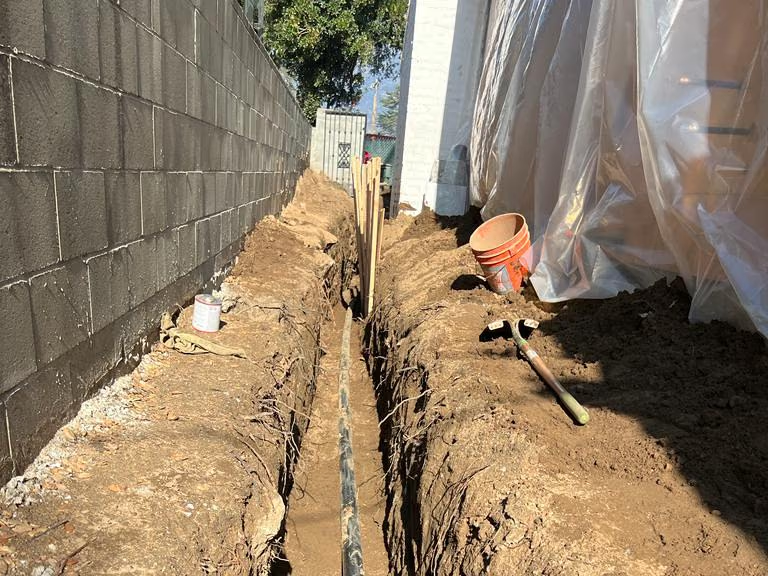
- In the City of Los Angeles the property owner owns and repairs the entire sewer lateral, including the section under the sidewalk and street.
- Cutting out tree roots in sewer line joints restores flow for a while and leaves the gap they came through.
- A liner or a new pipe closes every joint along the run, which is why only those two end the problem.
- LA Sanitation offers a camera rebate and a repair rebate for private laterals, and unlicensed or unpermitted work disqualifies both.
- Most trees can stay once the lateral is lined or replaced, because a jointless pipe gives the roots nothing to enter.
How do you know tree roots are in the sewer line?
The giveaways are gurgling from a tub or toilet, the lowest drain backing up first, and the same clog returning every winter. A camera confirms it.
In a one-story Valley tract home the lowest fixture is often a shower on the slab, so that is where the sewer announces itself. A hillside house in Tujunga or Sunland may show it at a laundry standpipe or a garage floor drain. If every fixture drains slowly at once, the trouble sits in the lateral, not in one branch line.
Outside, a strip of grass that stays greener than the rest, or a slight dip in the lawn, usually marks a leaking joint that roots have found.
One backup after a party is a clog, and a first-time clog is an ordinary drain cleaning in Los Angeles visit with a cable. The same backup every winter is a pipe problem, and LASAN says over half of sewer backups come from tree roots and from fats, oils and grease. Our guide on why a drain keeps clogging covers the cleaning side.
Who pays when roots clog the lateral: you or the City of Los Angeles?
You do. In the City of Los Angeles the property owner owns, maintains and repairs the entire sewer lateral. LASAN calls the run from the house to the property line the upper lateral and the run from there to the main, usually under the street, the lower lateral. Both are yours to repair with a licensed sewer contractor.
Outside the city limits the agency changes and the answer does not. La Crescenta and the other unincorporated pockets fall under the LA County Consolidated Sewer Maintenance District, which treats the whole lateral as the owner's. Burbank, Glendale and Pasadena run their own sewer utilities and permit counters. The City's sewer service charge steps up on a schedule through 2028 to pay for rehabilitating public sewer pipelines, and it does not change who owns the lateral.
What if a city parkway tree did the damage?
The lateral is still yours to repair. We are not aware of a case where the City reimbursed an owner for root damage from a parkway tree, so plan the repair as your own cost.
Parkway trees, the ones between the sidewalk and the curb, belong to the City, and so do their roots. A claim for damages can be filed with the City, yet it moves on its own track and does nothing to speed up a repair. The practical path is the camera, the written repair scope and the permit. Keep the recording, the locator marks and the invoice, because they are the evidence if you pursue a claim afterward.
A tree on your own property is simpler, because the roots, the pipe and the decision are all yours. A parkway tree generally cannot be removed or heavily root-pruned without the City's Urban Forestry Division signing off.
Why do roots keep coming back in a clay lateral?
Because the joint stays open. Cutting removes the root and leaves the gap it came through, so the same root grows back from the same seam.
Most of those seams are the mortar joints of pre-1970 clay pipe, laid in short lengths under Pasadena bungalows and 1950s Valley tracts alike. Expansive soil and decades of small quakes work them open. Mid-century Orangeburg is worse, a fiber pipe that goes soft and out of round, and only replacement fixes it. Our guide on a sewer camera inspection before buying a home describes both materials and what the camera finds in them.
A root needs water, and a leaking joint is a drip line. In our experience the worst offenders on Valley streets are ficus, magnolia and pepper trees, with camphor and jacaranda not far behind. Roots in a clay lateral are a symptom of a seam, not of a tree.
Saturated soil drives root growth, and the first storms push extra flow through a pipe that was already half roots. LA County's Board Chair issued a local emergency proclamation on September 23 ahead of this winter's El Nino storm season. The same outlook that has Public Works clearing flood channels sends root calls our way in January.
Does root killer poured down the drain work?
Sometimes, for a while, and only on roots the product can touch. Nothing poured down a drain closes the joint the roots came through.
Copper sulfate crystals are the old standby. Flushed down a toilet, they dissolve and run along the bottom of the pipe with the water. Roots hanging from the crown never meet the copper. The product carries use restrictions in some places, so read the label and check with LASAN first.
Foaming root killers do better, because the foam expands to fill the pipe, reaches the crown and kills the root tissue it coats. It helps most on a line that was just cut or jetted, since foam cannot reach a root behind a solid plug. Neither product repairs anything. A line on root killer is a line on maintenance, a fair choice for a light intrusion in sound clay and a poor one for a joint that has failed.
Root cutting, hydro jetting, lining or replacement: which fixes it for good?
Only lining or replacement fixes it for good. Cutting and jetting clear the pipe, while lining and replacing close the joints.
The camera comes first, because the finding picks the method. A sewer camera inspection in Los Angeles runs the lens through the lateral, and a locator marks each defect from above. A cable root cutter restores flow and buys months. Hydro jetting in Los Angeles scours cut roots and grease off the wall; we jet old clay only once the camera shows it can take the pressure.
A cured-in-place liner suits a cracked pipe that is still round and seals every joint from inside. Pipe bursting pulls a new pipe through the old path where a pit fits at each end. Open trench covers shallow runs, collapsed pipe and the shared laterals under older dingbat buildings. Current ranges are on our sewer line repair in Los Angeles page.
Fix by camera finding
| Method | Camera finding | Holds for | Pipe condition | Permit and rebate |
|---|---|---|---|---|
| Root cutting (cable) | Hair roots at one joint | Months; roots regrow | Any pipe a cable can pass | No permit; no rebate |
| Hydro jetting | Root ball or grease in sound clay | A season or so | Round, uncracked pipe on camera | No permit; camera may earn the CCTV rebate |
| Lining (CIPP) | Cracks or open joints along the run | Lasting; seals every joint | Round host pipe, no collapse or belly | LADBS permit on the lot, BOE S-permit under the street; repair rebate possible |
| Pipe bursting | Offsets or a run too far gone to line | Lasting; new pipe end to end | Room for a pit at each end | LADBS and right-of-way permits; rebate possible |
| Open trench | Belly, collapse, Orangeburg, shallow slab run | Lasting; all new pipe | Any; depth and access set the job | LADBS permit, right-of-way under the street; rebate possible |
If the same drain backs up every winter, book a camera before the rains and call (818) 421-5290. You get the recording and a written repair estimate.
Can you keep the tree and still fix the sewer?
Usually the tree can stay. Lining or bursting the lateral gives the roots nothing to enter, and a root barrier between trunk and pipe keeps them from trying.
The method matters more than the tree. A liner has no joints, and a new plastic pipe has fused or gasketed joints that roots cannot pry open. Once the seams are gone the root loses its water source and stops heading for the pipe.
Distance and species still set the risk: a jacaranda ten feet from the run is a different animal from a ficus two feet from it. On a trenched or pitted job we can set a root barrier panel along the new pipe. The tree usually comes out only when the lateral runs directly under the trunk, or when a new pipe would have to lie in the root ball. If the house has big trees and you are still in escrow, our buyer guide explains how to get the camera scope done inside the contingency.
How do the LASAN lateral rebates work, and what disqualifies you?
LA Sanitation offers two sewer lateral rebates to owners who pay the City sewer service charge: one for a camera inspection and one for a permitted repair. Unlicensed or unpermitted work disqualifies the application.
The CCTV rebate covers a camera inspection of the private lateral by a licensed and bonded sewer contractor, done no more than six months before you apply. The repair rebate covers a lateral repair by a licensed and bonded contractor, and the catch is timing. The City inspector must have signed the final permit on the repair and its inspection no more than 60 days before you complete the application. In the City of Los Angeles that repair permit comes from LADBS for the run on your lot; the lateral from the property line to the main needs a Bureau of Engineering S-permit, and work under the street has to be done by a City bonded sewer contractor.
The paperwork is the LASAN application, the contractor invoice showing the license number with itemized costs and proof of payment, the inspection video, a recent DWP bill and the parcel number, filed through MyLA311, with a W-9 once the rebate is approved. Applications open on the first workday of July each year and run first-come until the year's funds are gone.
A+ Electric & Plumbing is a licensed electrician and plumber serving Los Angeles and the San Fernando Valley, and the Tujunga crew that runs your camera also pulls the City permit the job needs, meets the inspector and hands you the video and invoice the rebate asks for. Everything else on the plumbing side is on our Los Angeles plumber page. When a backup has also soaked a garage outlet, one call to an electrician and plumber in Los Angeles covers both trades without finger-pointing.
Frequently asked questions
Will homeowners insurance pay for root damage to the sewer line?
Usually not. Standard policies tend to treat root intrusion, age and wear as maintenance, and the buried pipe itself is often excluded. Some carriers sell a service line endorsement that covers the lateral. A separate sewer backup rider pays for cleanup inside the house rather than the pipe. Check your own policy before you assume either applies.
How often do roots grow back after cutting?
In our experience a cut root in a leaking clay joint is back within months. A line cut in spring often backs up again by the first wet storms of winter. Jetting stretches that interval because it strips the root stubs and grease off the wall instead of leaving them to regrow.
My neighbors drain fine. Is the backup still my problem?
Almost always, yes. Each house has its own lateral, so a problem that stops at your property line is in your pipe, not the main. When several houses on the block back up together, or sewage rises in a street manhole, the main is suspect and LASAN's 24-hour line, 1-800-773-2489, is the right call.
What does mainline sewer repair cost in Los Angeles?
It depends on the method, the length of the run, how deep the pipe sits, and whether any of it lies under a driveway or the street. Work under the street adds a right-of-way permit and sometimes traffic control. A permitted repair by a licensed contractor can also qualify for a LASAN rebate. The firm figure goes on the written estimate after the camera visit.
Can a lateral be lined while the roots are still in it?
No. The line gets cut and jetted clean first. The camera then checks that the host pipe is still round and that the run has no low spot holding water. Any root stub left behind would print through the liner as a bump that catches paper. With a collapse or a deep belly, the liner cannot go in at all.
Related services
Need this handled? Start here
Get a free estimate
Tell us what's going on and a licensed tech calls you back fast, with the exact price before any work starts. Electrical and plumbing, one team.
Estimates for quoted work are free. Troubleshooting or diagnosis may carry a $100-$250 service call, credited to your repair when you approve the work.
- Exact price in writing before we start
- Licensed, bonded & insured (CSLB #942404)
- One team for electrical and plumbing
Prefer to talk? Call (818) 421-5290, answered 24/7.