Electrical guide
Electrical Emergency or Wait Until Morning? Eight Signs, Sorted by Who You Call First
Smoke, flames or sparks are an electrical emergency: call 911. A burning smell, a hot outlet, a buzzing panel, scorch marks, a breaker that will not hold, water in the panel, or half the house dead with nothing tripped mean tonight. Cut the circuit or the main and call an electrician. One dead outlet with no heat or smell can wait for morning. If the street is dark, call LADWP first.
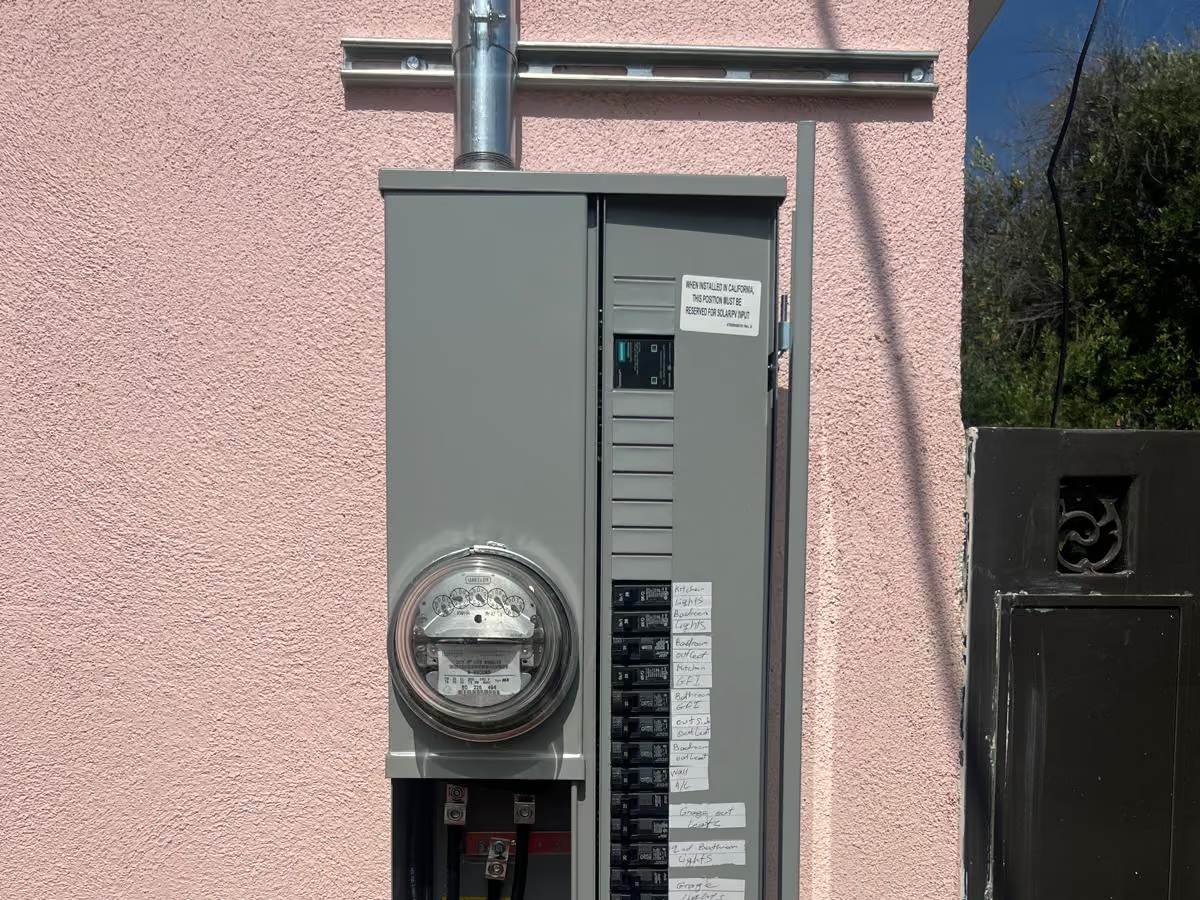
- A burning smell, a warm cover plate, a buzzing panel, scorch marks, a breaker that trips again on reset, water in the panel, or half the house dead with nothing tripped mean the circuit stays off and you call an electrician tonight.
- Half the house dead with nothing tripped often means a lost service leg or a loose neutral, which can push high voltage onto 120-volt circuits.
- When the whole street is dark, LADWP at 1-800-342-5397 comes before any electrician in the City of Los Angeles; Burbank, Glendale and Pasadena run their own utilities.
What counts as an electrical emergency in a home?
An electrical emergency is any fault that can start a fire or shock someone before morning. Eight signs cover nearly every night call we take in Los Angeles and the Valley.
One sorts itself: smoke, flames or sparks go straight to 911, because a fire inside a wall is past the electrician stage. Most of the rest earn a call tonight once the circuit, or the main, is off. The table marks the two exceptions: cold, odorless scorch marks wait for morning, and a sagging service drop starts with LADWP.
Eight warning signs: who to call and what to do now
| What you notice | 911, tonight, morning or LADWP | Do this now | What the visit usually involves |
|---|---|---|---|
| Smoke, flames or sparks | 911 | Get everyone out | Fire crew first, electrician after |
| Burning smell, no visible source | Tonight | Circuit or main off; leave and call 911 if it stays strong | Thermal scan, repair of the hot connection |
| Outlet, switch or plate warm to the touch | Tonight | That circuit off | Replace the device, check the wire |
| Buzzing, crackling or sizzling panel | Tonight | Main off if dry; never remove the cover | Meter and thermal check of breakers and bus |
| Scorch marks on a plate or breaker | Tonight if warm or fresh; morning if cold and odorless | That circuit off either way | Replace the device, inspect behind it |
| Breaker trips again the moment you reset it | Tonight; stop resetting | Leave it off; unplug everything on it | Trace the short or ground fault |
| Half the house dead, nothing tripped | LADWP if the drop sags or neighbors share it; else tonight | Unplug electronics; check the drop from the ground | Find the lost leg or loose neutral |
| Water in the panel, meter or an outlet | Tonight; LADWP too if the meter is wet | Hands off; call from a dry spot | De-energize, dry, replace corroded parts |
Quiet now and warm an hour later moves a sign up a row, and two signs together always mean tonight.
Burning smell from an outlet or panel: is that an emergency tonight?
Yes, tonight. A burning or hot-plastic smell means a connection or a wire's insulation is overheating, and that heat does not stop on its own. Turn off the breaker for that circuit, or the main if you cannot tell which, and call.
The smell is the tell, not the heat you can feel. Insulation cooks well below the temperature at which a cover plate feels hot, so a faint fishy or sharp plastic odor near a switch is an early warning. In 1950s and 60s Valley tract homes we trace most of these to a backstabbed receptacle or a loose breaker screw.
Look for the source from the room: a warm plate, a discolored outlet, a dimmer that smells. Do not open anything. If the smell stays strong with the power off, or you see smoke, leave and call 911; a fire in the framing keeps going without electricity. Once the house is safe, an emergency electrician finds the connection that cooked.
Half the house lost power but no breaker tripped: what does that mean?
It usually means one of the two 120-volt legs feeding your panel has dropped, or the neutral has come loose between the pole and your main lugs. Either one is a tonight problem, and the loose neutral is the dangerous one.
Your house receives 240 volts as two 120-volt legs that share a neutral. Lose a leg and half the circuits go dead while the rest work. Lose the neutral and the two halves trade voltage: one side glows bright, the other dims, and anything electronic can see far more than 120 volts.
Unplug the expensive equipment first, then look up from the yard. If the drop from the pole sags, a splice at the weatherhead hangs loose, or the neighbors share the symptom, LADWP takes the call. If the drop looks fine and only your house is affected, the loose spot is usually at the meter or in the panel. That is electrical repair in Los Angeles work for a licensed electrician tonight.
Santa Ana season is when these calls cluster. During the October 15-17, 2026 red flag event, gusts of 50 to 70 mph worked overhead drops for three days. Southern California Edison cut power to more than 60,000 customers under its Public Safety Power Shutoff program.
Power out only at your house: LADWP or an electrician first?
Check the street first. If the whole block is dark, it is a utility outage: report it to LADWP at 1-800-342-5397 or on the LADWP outage map; no electrician can fix it. If only your house is dark, look at the main breaker before you call anyone.
A tripped main sits in the middle position or feels loose. Push it fully off, then on, once. If it trips again, leave it off and call an electrician; a main does not trip for fun. If the main is on and the house is still dead, LADWP checks the utility side of the meter and an electrician checks yours. In a dingbat apartment building, find your own meter in the bank first; a dead unit beside live neighbors is often one tripped main in a row of eight.
Which utility is yours depends on the address. The City of Los Angeles, including most of the Valley and our own Tujunga neighborhood, is LADWP territory. Burbank, Glendale and Pasadena run municipal utilities with their own outage lines. La Crescenta and La Cañada Flintridge are generally Southern California Edison territory.
SCE is the local utility that runs planned Public Safety Power Shutoffs in high wind; LADWP has historically said it does not run planned shutoffs, though it will de-energize lines when fire officials ask during a Red Flag event, as it did in January 2025.
Is a warm outlet or buzzing panel an emergency if it stops when you cut power?
Yes, it is. Cutting the power stops the symptom, not the fault. The loose or arcing connection is still inside the box, and it heats up again the moment the circuit is live.
A faint hum from a panel is normal. A buzz you hear across the room, a crackle, or a sizzle is arcing, a tiny continuous spark eating the contact and the dust around it. A warm outlet or switch plate is the same story one step earlier.
Sleeping is fine with the circuit off. Sleeping with it on, because the smell went away, is the mistake that turns a repair into a fire call. If the buzz comes from the panel and you cannot tell which breaker owns it, switch the main off.
If you cannot find the source, leave the power off and call (818) 421-5290; a live person answers at night. How a night visit is priced gets explained on that call, in plain words, before we send anyone.
What should you shut off, and not touch, before the electrician arrives?
Shut off the one circuit if you know it, the main if you do not, and nothing else. The dead-front cover stays on the panel, a wet panel stays untouched, and no extension cord bridges a dead circuit from a live one.
- One circuit or the main. Match the breaker to the room if you can; otherwise, or if the panel itself buzzes, switch the main off.
- Never remove the dead-front. The screws on the inner cover are the line between homeowner and electrician; the service lugs behind it stay live even with the main off.
- Wet is hands-off. Rain blowing into an outdoor panel, a meter socket on a flooded slab, an outlet under a leaking window: do not touch the breaker or stand in the water. Call from a dry spot.
The first winter storms are when the wet-panel rule earns its place. After the first real rain each year, our Tujunga shop hears from hillside homes whose outdoor panels face the weather, and the neutral bar is usually what corroded. When a burst supply line rather than the sky soaked the wall, one electrician and plumber in Los Angeles on a single license handles both. The wet wall and the circuit inside it get one crew and no finger-pointing.
What happens when you call an emergency electrician at 11 pm?
A live person answers, asks what you see and smell, and talks you through making the house safe. A licensed electrician then makes the fault safe and puts the permanent fix in writing.
We ask whether anything is still hot or smoking, which breaker is off, and whether the neighbors have power, because those three answers sort 911, LADWP and electrician. A+ Electric & Plumbing is a licensed electrician and plumber serving Los Angeles and the San Fernando Valley, and the same night line that sends the electrician sends the plumber when a leak soaked the outlet.
The tech checks the panel with a meter and a thermal camera, finds the hot connection, and either repairs it on the spot or isolates it until daylight. You get the explanation and a written OK before any repair starts, the same rule our electrician in Los Angeles pages describe for daytime work.
Some fixes wait for a permit by design. A panel or service change in the City of Los Angeles needs an LADBS permit and an inspection, with express permits generally filed online. A night call that finds a scorched main lug ends with a safe temporary setup. The permanent repair waits for its permit, which we file with LADBS before that work starts.
When is the real fix the panel or the circuit, not tonight's make-safe?
When the same symptom comes back, or when the panel itself is a brand or an age that fails. A make-safe buys a night; a repeat fault is the house telling you the circuit or the panel needs replacing.
Valley tract homes from the 1950s through the 70s carry the usual suspects: a 100-amp panel feeding central air, two-wire circuits with no ground at the outlets in many of the 1950s and early-60s houses, and aluminum branch circuits in homes wired between about 1965 and 1973. Those aluminum connections loosen a little more every summer, and the hot summer of 2026 loaded them for months.
A breaker that trips over and over has its own guide: our breaker keeps tripping article explains the trip patterns. If the panel door says Federal Pacific, Stab-Lok or Zinsco, read why electricians replace Federal Pacific panels, because those breakers can fail to open at all. The permanent fix is usually an electrical panel upgrade in Los Angeles, permitted through LADBS. The current California Electrical Code generally adds an outdoor emergency disconnect whenever the service equipment changes.
If tonight's fault was the third odd symptom this year, book the walk-through in our electrical safety inspection checklist and let the written report set the order of repairs.
Frequently asked questions
Is an outlet that sparked when I plugged something in an emergency?
A small blue spark at the instant the plug seats is normal. A spark that is large, yellow, lingers, or leaves a black mark on the plug or the outlet is not. If the outlet also feels warm, smells, or sparks with the plug fully in, switch the circuit off and have it checked before you use it again.
Is one flickering light an emergency if nothing else is wrong?
Not tonight, if the fixture and its switch stay cool and odorless. One light flickering by itself points to that fixture, not the house. A loose bulb, a worn switch or dimmer, or an LED on the wrong dimmer explains most of them. Switch it off and book a daytime visit. Flicker that spreads to other rooms, or pairs with brightening elsewhere, points to a loose neutral, and that does not wait.
Are lights that dim when the AC or fridge starts dangerous?
A brief dip when a compressor starts is normal in an older house on 100-amp service; the motor pulls a surge of current and the lights show it. Dimming that lasts, grows worse over weeks, or pairs with brightening in another room points to a loose neutral or a tired connection, and that one does not wait.
Is a GFCI that will not reset an emergency?
Usually not tonight, if nothing is warm or smells. A GFCI that refuses to reset is often doing its job: there is still moisture or a faulty device downstream, or the GFCI has worn out. Unplug everything on the circuit and try once. If it still will not reset, leave it and book a daytime repair; if it resets and the outlet is warm, cut the breaker and call.
I rent. Who do I call for an electrical emergency, the landlord or an electrician?
Call 911 for fire or smoke first. For anything else, switch the circuit off, then call the landlord or the building's emergency line. The owner is responsible for the wiring and the panel, and in a multi-unit building your main may sit in a locked meter room. If nobody answers and the fault is active, an electrician can make it safe, and the written findings go to the owner.
Related services
Need this handled? Start here
Get a free estimate
Tell us what's going on and a licensed tech calls you back fast, with the exact price before any work starts. Electrical and plumbing, one team.
Estimates for quoted work are free. Troubleshooting or diagnosis may carry a $100-$250 service call, credited to your repair when you approve the work.
- Exact price in writing before we start
- Licensed, bonded & insured (CSLB #942404)
- One team for electrical and plumbing
Prefer to talk? Call (818) 421-5290, answered 24/7.