
Electrical guide
Water in the Electrical Panel After Rain: What to Do First and What Gets Replaced
Water in electrical panel wiring or breakers is a hands-off problem. Do not touch the panel, do not open it, and do not stand on wet ground in front of it. Call your utility if the meter or the box that holds it is wet, and a licensed electrician for everything on your side. An electrician replaces soaked breakers and outlets instead of drying them, and has to find the leak before the next storm.
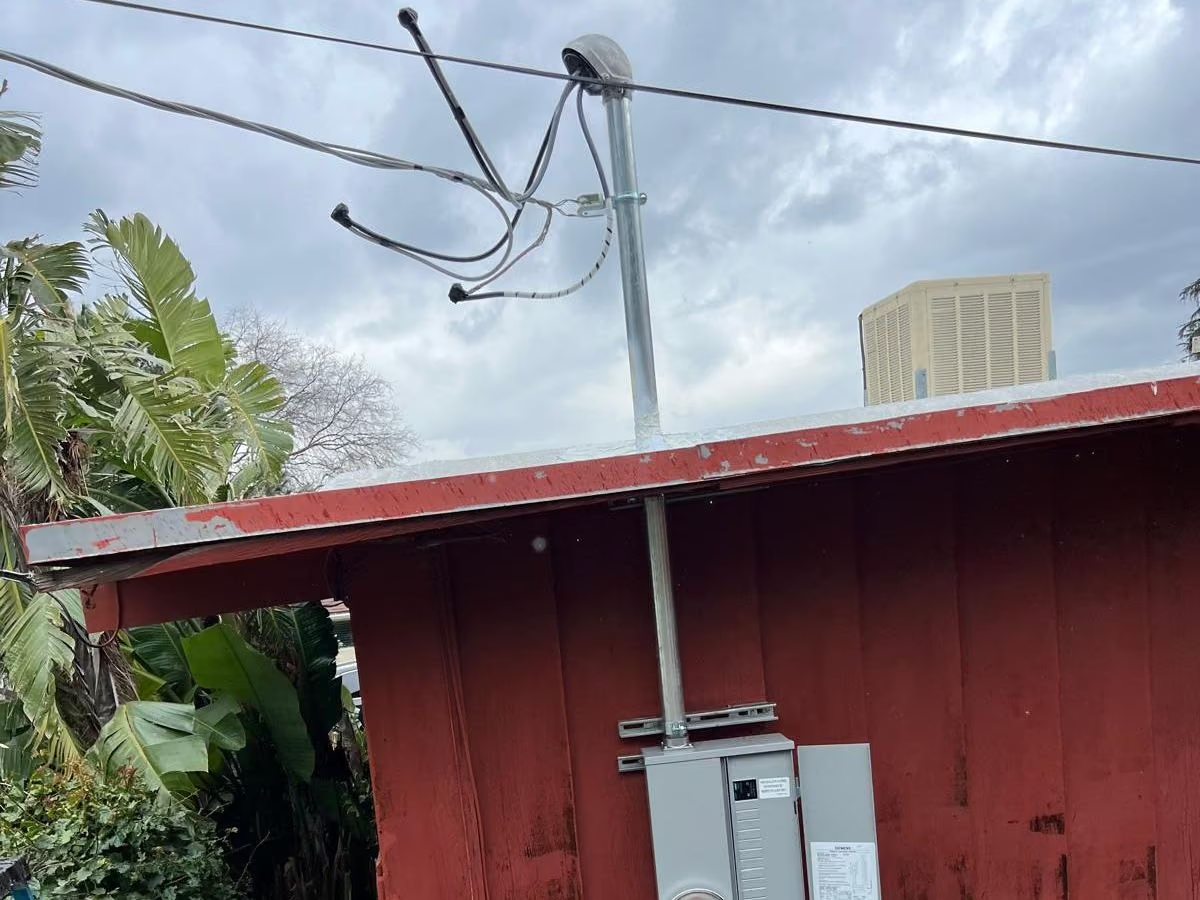
- Leave a wet panel alone. The CDC's flood guidance says never to turn power on or off while standing in water, and to switch off the main only from a dry location.
- In LADWP territory the utility owns the service drop and the meter, and the customer owns the weatherhead, the riser, the meter enclosure and the panel.
- NEMA's guide to water-damaged equipment, written for floods, lists circuit breakers, GFCI and AFCI devices, outlets, switches and dry-location cable under replace. For the panel itself it says to contact the manufacturer.
- Water in electrical panel enclosures often arrives along the service entrance: the weatherhead, the mast, the fitting on top of the meter box, or a conduit from below.
- Most electrical repair work in the City of Los Angeles needs an LADBS permit, and LADWP's customer guide has LADBS inspect and release the work before LADWP energizes a new or revised service.
Is water in the electrical panel an emergency?
Yes, while it is wet. Water bridges parts that should stay apart, and a breaker with water inside may not trip when it should. Treat a dripping or buzzing panel, or one that smells hot, as a call for tonight, and do not touch it to feel for warmth. Old rust on a dry, quiet panel can wait for a daytime visit, but not for next winter.
What you see at the panel, and how fast to act
| What you see | How urgent | Who to call |
|---|---|---|
| Water dripping from the panel or the meter box, or pooling under it | Now | An electrician; your utility too if the box holds the meter |
| Buzzing, crackling or a hot, burnt smell | Now | An electrician; 911 if you see smoke or sparks |
| Water or fogging inside the meter glass | Now | Your utility first; the meter is theirs |
| Breakers tripping in the storm, no water at the panel | Today; leave them off until the rain has stopped and the ground in front of the panel is dry | An electrician |
| Rust streaks under the box, panel dry and quiet | This week | An electrician, for an inspection |
| A wire down or dangling | Now; stay at least 100 feet back | 911, then your utility |
| A wire sagging low but still attached | Now; stay back | Your utility's emergency line |
Our guide on whether a fault is an electrical emergency or can wait until morning covers the other warning signs.
What should you do first, and what should you leave alone?
Step back and make the calls from a dry place. The safe list is short, because almost everything you could do at a wet panel makes it more dangerous.
- Do not touch the panel or the meter
No breakers, no door, no cover. The inner cover stays on in every case, since the incoming wires behind it stay live even with the main off.
- Stay off wet ground in front of it
Keep children and pets away from the wall. A wet slab or wet soil under a wet metal box is the path you do not want to be part of.
- Use the main only if it is dry
If the water is somewhere else, such as an outlet or a ceiling, and the panel is dry, switch off the main from a dry spot, or just that circuit if you are sure which breaker it is. The CDC's flood guidance sets the same limit: main off only from a dry location, never while standing in water. In rain, an outdoor panel does not count as dry.
- Call the utility if the meter box is wet
Report it on the utility's emergency line and say the meter box is wet. Only the utility can cut power ahead of the panel. Call an electrician as well, and do not wait on one for the other. FEMA's hurricane guidance covers the flooded case: when water has covered outdoor service equipment, the power company removes its meter before anyone goes inside.
- Do not dry it or spray it
No towels, no hair dryer, no water-displacing spray. Drying the outside does nothing for the water inside a breaker.
- Take photos from a distance
Photograph the drip, the stain and where the water seems to come from. They help the electrician, and an insurer will ask for them.
Who to call, by what is wet
-
Smoke, flames, sparks, or a wire downStay far back and treat every wire as live911
-
LADWP customers: wet meter box, sparking on the utility wires with nothing burning, power emergencyLos Angeles Department of Water and Power, 24 hours1-800-342-5397
-
Southern California Edison customers: safety problem at the line or the meterSCE safety line1-800-611-1911
-
Burbank: power off or lines down, nights, weekends and holidaysBurbank Water and Power emergency services; weekdays 7:30 am to 5 pm call (818) 238-3700(818) 238-3778
-
Pasadena: power emergencyPasadena Water and Power(626) 744-4673
-
A wet panel, a dead circuit or a breaker that will not resetA+ Electric & Plumbing; a live person answers 24/7(818) 421-5290
How does rain get into a panel?
Often from above, along the wires that feed it. On an overhead service the conductors drop from the pole to a weatherhead, run down a metal mast through the roof edge, and enter the top of the meter box. Each joint on that path can let water in, and the pipe then carries it straight to the breakers.
- Weatherhead and drip loops at the top of the mast.
- Roof flashing where the mast passes through.
- Fitting where the mast enters the top of the box.
- Door, cover and the wall seal around the box.
- Conduit that enters from below.
- Weatherhead and drip loops. The wires should dip below the head before they enter it, so water falls off at the low point. A cracked head or a missing loop sends water into the mast.
- Roof flashing. Where the mast passes through the eave, a dried-out boot lets roof water run down the outside of the pipe to the box.
- The fitting on top of the box. Where a pipe enters an outdoor box above its live parts, the California Electrical Code calls for a fitting listed for wet locations.
- Door, cover and wall. An outdoor panel sheds rain only as long as its door closes. A bent door, or a gap in the wall finish around a recessed box, can let wind-driven rain in.
- Conduit from below. A buried conduit that runs downhill toward the house can deliver water into the bottom of the panel. That one is less common.
In the Valley the panel is usually outside: a meter and breakers in one gray box on a stucco wall. Hillside homes add wind. From a safe distance, look for rust at the bottom of the box and water stains on the mast or at a conduit elbow. A stained label inside the door is one more sign, and that one is for the electrician to find.
Who owns which part: you or the utility?
The utility owns the wires to the house and the meter. You own everything that receives them. LADWP's service rules put the service drop and the meter on the Department's side, and the service entrance conductors, the service equipment and the box that holds the meter on the customer's side.
Overhead service in LADWP territory: whose part is it?
| Part | Owner | Who fixes it |
|---|---|---|
| Service drop, from the pole to the house | LADWP | LADWP |
| Meter | LADWP | LADWP |
| Weatherhead, mast and the wires inside it | You | A licensed electrician, with a permit |
| Meter box and main panel | You | A licensed electrician; the utility cuts and restores power |
| Breakers, circuits and outlets | You | A licensed electrician |
LADWP's outage line runs around the clock for emergencies. Southern California Edison and Burbank Water and Power draw the line in the same place in their own rules. Glendale and Pasadena run their own utilities, so ask them where theirs sits. LADWP's rules also say it takes on no duty to inspect a customer's wiring. That is why a wet panel takes two calls and not one.
Can you dry out a wet panel, or does it need replacing?
Breakers and devices that were soaked need replacing. The box and its bus may survive, and that depends on the maker and on what the electrician finds. Drying is not a repair, because minerals and grit stay inside a device after the water is gone.
What NEMA's flood guide says about water-damaged equipment
| Part | NEMA guidance | In a house |
|---|---|---|
| Circuit breakers | Replace | Water and grit affect the trip mechanism and the contacts |
| GFCI and AFCI breakers and outlets | Replace; do not wash or air dry | The electronics hold sediment after drying |
| Outlets, switches and dimmers | Replace | Sediment stays inside after drying or washing |
| Surge protector at the panel | Replace | Same reasoning as the other electronics |
| Dry-location cable, such as NM-B | Replace | Where water reached the cable itself |
| The panel itself (panelboard) | May be reconditioned; contact the manufacturer | On an old panel, a new one is usually the practical answer |
The guide is NEMA CS 70006-2026, Evaluating Water-Damaged Electrical Equipment, formerly numbered GD 1. NEMA wrote it for flooding and other events with large amounts of water, and it has no line for a panel that only took a drip. The Consumer Product Safety Commission draws its own line at devices that have been under water. For rain intrusion, the call belongs to the electrician and the inspector on site.
Brand matters too. The guide on Federal Pacific and Zinsco panels explains why those two are not worth saving, and the electrical panel upgrade page covers what a new one involves.
Why does a breaker or GFCI trip only when it rains?
Because water has reached something on that circuit outdoors. A GFCI trips on a few thousandths of an amp leaking to ground, and a wet box or a wet cord leaks more than that. The device is doing its job, so the fix is to find the wet spot, not to keep resetting.
- An outdoor outlet whose cover does not close over the plug. The code calls for a weather-resistant outlet and an in-use cover in wet locations.
- String lights, a fountain pump or an extension cord left plugged in.
- Landscape lighting, with a transformer or a buried splice that has taken on water.
- Pool, spa or gate equipment on an outdoor circuit.
- A light fixture or a doorbell transformer on a wall that takes the rain.
Wait until the rain stops and the outlet, the cords and your hands are dry. Then unplug everything outside and press reset once. Leave it alone if you see water in the outlet or under its cover. If it holds, reconnect one item at a time on a dry day. If it trips with nothing plugged in, a box or a splice further down the line is wet, and tracing it is electrical repair in Los Angeles work. A GFCI outlet that sat in water needs replacing. Our guide to a breaker that keeps tripping covers the other patterns, and outlet installation in Los Angeles covers a proper outdoor outlet.
What does the repair involve in Los Angeles?
It has three parts: make it safe, stop the water, and replace what the water damaged, with a permit and an inspection for most of that work. LADBS states that electrical permits are required for any electrical work. The code exempts a short list of small like-for-like swaps, and your electrician can tell you whether a swap after water damage still counts.
Making it safe does not wait for paperwork. An emergency electrician isolates the wet equipment and leaves the dry circuits running where that can be done safely. The permit for the permanent repair follows.
Reconnection has its own order. LADWP's guide for customers covers new and changed services. It has LADBS approve the work and send its release to LADWP before the power goes on, and it says to allow several days for that release. We found no separate LADWP steps for a storm shutoff. Ask what it needs when it cuts the power, and do not count on power the same evening.
Replacing the service equipment also brings it up to the current code. As we read the 2025 California Electrical Code, which applies to permits filed since January 1, 2026, replacing the service equipment on a house adds an outdoor emergency disconnect and surge protection. Ask whoever quotes the job to show both on the estimate.
How do you keep rain out before the next storm?
Look at the service from the ground on a dry day, and have anything doubtful fixed before the rain returns. Do these checks by eye.
- Follow the wires from the pole to the house. They should dip in a loop before they enter the weatherhead, and the head should sit upright and whole.
- Check that the mast is straight and firmly strapped, and that the flashing around it at the roof is not cracked.
- Look under the panel for rust trails and on the wall for a water track from the top of the box.
- See that the panel door sits closed and latched, and that sprinklers do not hit the box.
- Watch for branches resting on the service drop. Call your utility about a tree touching the line, and never trim near it yourself.
A+ Electric & Plumbing is a licensed electrician and plumber serving Los Angeles and the San Fernando Valley, and an electrical safety inspection early in the wet months is the quiet way to find a leaking service. Water at an outlet on an outside wall can also come from a pipe, and one crew with both trades can tell which. The other electrical work we do is on the Los Angeles electrician page. When a leak turns out to involve a pipe as well, the home page shows how one electrician and plumber in Los Angeles covers both.
Frequently asked questions
Can I turn off the main breaker if the panel is wet?
Not if the panel itself is wet. The main breaker sits in the same wet box, and you would be touching it while standing in front of it. Stay back and call an electrician, and your utility too if the box holds the meter. If the panel is dry and the water is somewhere else in the house, switching the main off from a dry spot with dry hands is the right move.
Do circuit breakers have to be replaced after they get wet?
If water soaked or covered them, yes. NEMA lists molded-case breakers under replace, and the Consumer Product Safety Commission says to discard breakers and GFCIs that have been under water, even if they still seem to work. For a few drops on the outside, an electrician decides on site. Drying a breaker does not make it safe again.
Is rust in the panel dangerous if everything still works?
It can be. Rust means water has been in the box before, and corrosion at the neutral bar or where a breaker clips to the bus adds resistance and heat. Home inspection sources also warn that a corroded breaker may not trip on overload. A dry, quiet, rusty panel is not an overnight emergency, but it needs an inspection soon.
Who do I call first, the power company or an electrician?
Go by what is wet. The wires from the pole and the meter itself belong to the utility, so call it first for those. A wet box that holds the meter gets both calls: the utility and an electrician. A wet indoor panel or subpanel is yours, so call an electrician, who will bring the utility in if the service has to be cut. Smoke, sparks or a wire down is a 911 call before either.
Does homeowners insurance pay for a panel damaged by rain?
It depends on how the water got in and on your policy. The California Department of Insurance lists sudden and accidental water damage among typically covered causes, and seepage, leaks and maintenance among those generally not covered. Photograph everything before anyone touches it, keep the replaced parts until the adjuster has seen them or released them, and keep your receipts.
Why is my patio outlet dead after the rain?
Most often a GFCI tripped somewhere upstream. Look for one with a popped button in the garage, a bathroom, the kitchen or another outdoor box, since one device often protects several outlets. Once the rain has stopped and everything is dry to the touch, unplug what is outside and reset it once. If it will not reset or trips again, leave it off and have the wet point traced.
Get a free estimate
Tell us what's going on and a licensed tech calls you back fast, with the exact price before any work starts. Electrical and plumbing, one team.
Estimates for quoted work are free. Troubleshooting or diagnosis may carry a $100-$250 service call, credited to your repair when you approve the work.
- Exact price in writing before we start
- Licensed, bonded & insured (CSLB #942404)
- One team for electrical and plumbing
Prefer to talk? Call (818) 421-5290, answered 24/7.